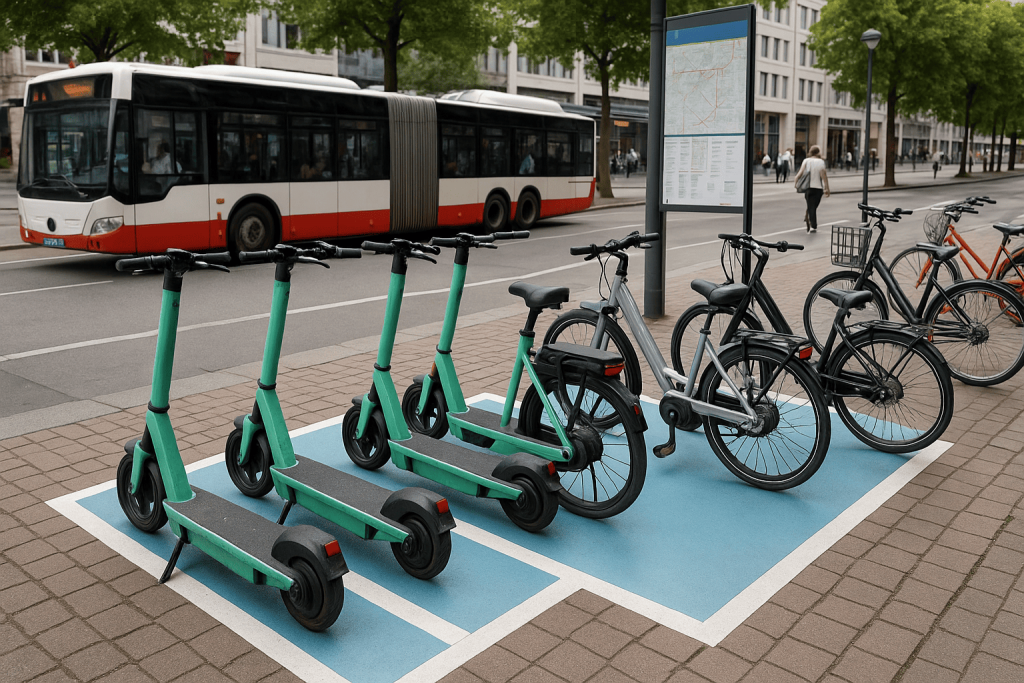
European cities don’t need more gadgets on the curb—they need cleaner, quicker first/last-mile trips that slot neatly into public transport (ÖPNV). Done right, shared scooters and e-bikes become the low-friction glue between bus, tram, and rail. Done wrong, they’re clutter and complaints. Here’s how to build a city playbook that keeps streets orderly, riders happy, and emissions falling. 🚲🛴
Start with the network, not the vehicle. Micromobility succeeds when it mirrors transit: predictable, legible, frequent. That means focusing fleets and parking near stations, high-demand corridors, and dense housing—not scattering devices thinly “everywhere.” Treat scooter and e-bike supply like bus frequency: concentrate where interchange benefits are highest, then expand stepwise.
Hubs beat chaos. Replace free-floating parking with well-signed micromobility hubs at transit stops—painted boxes, modular racks, and corral islands that fit within existing curb space. Add wayfinding pylons, lighting, and tactile paving for accessibility. Hubs cut sidewalk clutter and slash retrieval costs for operators while making the system visually obvious to new users. 🎯
Digital rules, physical cues. Geofenced slow-zones around promenades and shared spaces, plus no-ride/no-park zones where conflicts are unavoidable, turn complaints into compliance. Pair the geofence with physical design—planters, bollards, rumble paint—to nudge behavior even when GPS drifts. Clear in-app maps and on-street signage keep expectations aligned.
Real intermodality = one app, one receipt. Integrate scooters and e-bikes into the regional MaaS app so riders can plan, unlock, and pay for the entire trip in one flow. Bundle products (e.g., “tram + 10 minutes scooter”) and cap daily spend across modes. When the price signal rewards rail + micromobility over car, mode shift follows.
Data standards make it scalable. Require open, privacy-preserving feeds (e.g., GBFS for availability; compliance telemetry for parking) and standardized reporting windows. Use data to right-size fleets by district and time of day, rebalancing to station hubs before peak commutes. Publish performance dashboards so residents see progress, not just promises.
Safety by design, not slogans. Build protected bike/scooter lanes on commuter alignments to stations; tighten turning radii at intersections; give bikes-and-scooters their own signal phase where speeds differ from cars. Mandate high-lumen lights, dual brakes, and swappable batteries with thermal protections in shared fleets. Encourage helmets via station-adjacent vending and employer stipends without making them a barrier to spontaneous trips.
Parking policy that actually sticks. Make legal parking the easiest choice: hubs every 100–150 m in dense cores and at every station entrance. Require a photo at end of trip and automate fines for bad parking (operator-side first, user-side for repeat issues). Reward good behavior with ride credits for hub returns or off-peak rebalancing tasks (“community charging”).
Equity isn’t an afterthought. Offer discounted passes for low-income riders tied to existing transit concessions, cash-based top-ups at kiosks, and device distribution into underserved districts—not just tourist cores. Provide adaptive devices and cargo e-bikes at select hubs to support a wider range of riders and small-business logistics.
Operations that respect the neighborhood. Set quiet-hour servicing rules; require e-cargo or electric vans for swaps; and cluster swap lockers near stations to shrink operator mileage. Swappable batteries reduce truck rolls and let crews maintain uptime without street pile-ups. Clean, orderly hubs earn political capital that keeps programs alive.
Climate math that lines up. Prioritize renewable-powered depots and overnight charging, then measure grams CO₂e per trip including servicing. Right-sized fleets and station-centric parking cut idle battery losses and “deadhead” miles, making micromobility a genuine emissions win rather than a marketing claim. 🌱
Schools, employers, and events as amplifiers. Put hubs at campuses and corporate sites; sell bulk passes; sync arrival/departure waves with transit headways. For stadiums and fairs, stand up temporary corrals with staffed marshals and clear egress routes—proof that order is possible even at peak crowds.
Procurement that rewards outcomes. Concession models should tie permits to service quality: station availability near ÖPNV, parking compliance, crash reporting, and satisfaction. Use rolling scorecards to allocate more devices to strong performers and fewer to laggards; renew permits based on demonstrated public value, not pitch decks.
Comms that teach the “how.” A short, multilingual playbook—“Where to ride, where to park, how to connect to ÖPNV”—beats long PDFs no one reads. Put QR plaques at hubs with quick tips, station maps, and emergency contacts. Normalize etiquette: ring before passing, yield to pedestrians, park in marked bays. A courteous culture is an infrastructure multiplier. 🙂
Future-proof the curb. Paint now, pour later: pilot with striping and modular hardware, then harden successful hubs with power, sensors, and canopies. Design bays to flex between scooters, e-bikes, cargo bikes, and bike-share as demand shifts. Treat the curb as a dynamic asset, not a fixed puzzle you solved once.
Conclusion. Micromobility becomes ÖPNV’s best friend when cities swap laissez-faire scatter for station-centric hubs, unified payments, protected lanes, and data-driven fleet management. The result is tidy sidewalks, faster door-to-door trips, and fewer short car journeys. Build for the rider’s whole journey—not just the last 500 meters—and scooters and e-bikes will boost your transit ridership, not compete with it. ✅
I just wish they would be more accessible. In my town, in order to use one of these, you have to download an app, put credit in it, do this verification, do that step. I just wanna go man 😀 Maybe there are like this out there, I wish I could just pull out my credit card, swipe it, and its ready to go. Easy, fast, without thousands of verification steps.