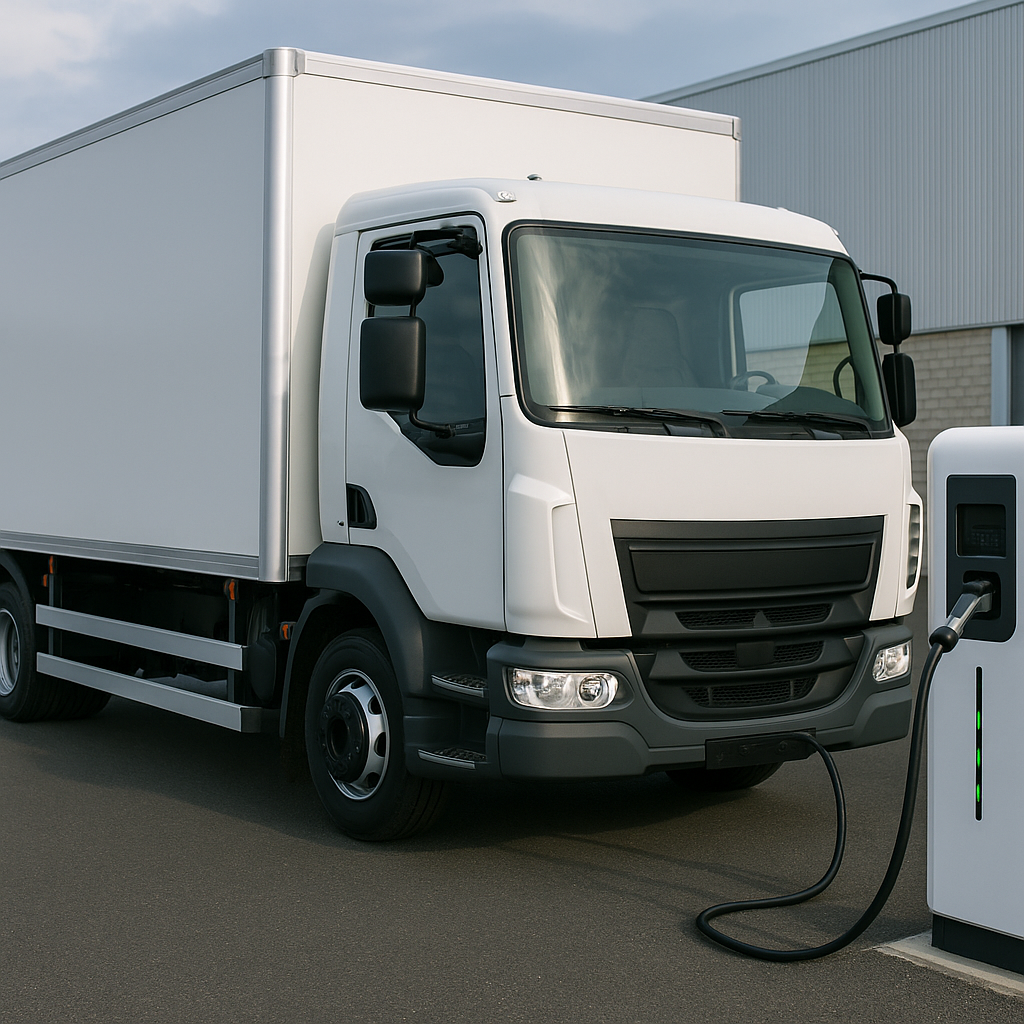
Why last-mile goes electric first. Urban delivery is tailor-made for electrification: short fixed routes, lots of stop-start (hello, regen), predictable dwell at depots, and strict city emissions/noise rules. When you control both the route and the plug, you control total cost of ownership (TCO)—and that’s where electric light/medium trucks start beating diesel on real money, not just ideals. 🚚⚡
Duty cycles define everything. A typical last-mile truck (N1/N2 or Class 3–6) runs 80–180 km per day with dozens of stops, spends nights parked, and rarely maxes highway speeds. Energy use sits around 0.7–1.2 kWh/km depending on mass, aero, and climate. That predictability lets you size the battery for the day—not for the rarest day of the year—and design charging around cheap, off-peak windows.
Headline TCO math (sanity check). Assume 120 km/day, 300 days/year, and 0.9 kWh/km → ~32,400 kWh/year. At €0.12/kWh depot off-peak (including losses), energy costs ≈ €3,900/yr. A comparable diesel at 13 L/100 km and €1.60/L burns ~6,240 L/year → ~€9,980/yr in fuel. That’s ~€6,000/yr fuel delta before maintenance. Add ~€800–€1,500/yr maintenance savings (no oil/DPF/EGR, fewer brakes thanks to regen), and you’re commonly €6,800–€7,500 ahead per truck per year. Multiply by fleet size; that’s your electrification budget. 📉
What kills payback—and how to avoid it. Three culprits: buying way more battery than you need “just in case,” paying peak tariffs, and relying on public DC for routine energy. Fix it by route-based right-sizing, strict off-peak scheduling, and depot-first energy. Public DC is a contingency, not your base plan.
Battery chemistry: pick for mission, not brochure. LFP/LMFP packs shine for last-mile: safe, robust, and tolerant of partial SoC bands. They trade a bit of energy density for calendar/cycle durability—fine when you own the depot. Nickel-rich NMC is lighter and better for long range or high power duty but isn’t necessary for most vans/rigids delivering in cities.
How long will the pack last? Expect modern LFP/LMFP packs to retain ~80%+ after 2,000–3,000 full-cycle equivalents when kept in a 20–80% SoC window and reasonable temps. In last-mile, you rarely deep-cycle—lots of shallow cycles add up more gently. That’s why five to ten years of service is achievable if you (a) finish charging near dispatch time, (b) avoid parking hot at 100%, and (c) keep the thermal system happy.
Charging blueprint: “AC at scale, DC on demand.” The backbone is overnight AC (11–22 kW) per bay or via load-balanced clusters. At 11 kW you refill ~90–100 kWh in 8–9 hours—enough for the vast majority of routes. Add a few shared DC posts (50–150 kW) for midday top-ups or schedule slips. Put metering and controls on the depot side so the fleet manager, not the driver, decides when electrons flow.
Power math you can build around. Ten trucks at 11 kW would ask for 110 kW if all charged flat-out. Smart charging seldom needs that: staggered starts, SoC targets, and time-of-use (TOU) windows typically cut the coincident peak by 40–70%. Many depots run 10–20 vehicles behind a 100–150 kVA service without upgrades by exploiting dwell time. Battery-buffered DC can shave peaks further if tariffs are punitive.
Tariffs are your hidden margin. The same kWh can cost 2–3× more at the wrong hour. Import your TOU prices into the charger backend, set hard “no-charge” windows, and aim to finish charge just before roll-out. Cheap night power + preconditioning while plugged in = lower cost, happier drivers, better winter range. ❄️
Opportunity charging: useful, not mandatory. If a route returns for lunch or passes your depot mid-shift, a 20–40 minute 50–100 kW top-up gives enormous buffer. If not, don’t chase it. Sizing the pack for 1.2× your worst-case day plus weather margin is usually cleaner operationally than peppering the city with fast chargers you won’t fully utilize.
Telematics is where savings compound. Track kWh/km by route, stop density, temperature, and driver. Use this to (1) assign vehicles by true energy need, (2) cap speed where aero hurts, (3) detect outlier auxiliaries (HVAC/reefer loads), and (4) auto-generate the nightly charging schedule to hit the cheapest hours with the lowest feasible peak.
Cold and hot weather playbooks. Cold raises consumption 10–30% in vans (cabin heat + viscous losses). Preheat on the cord, aim to depart at temperature, and enable heat-pump priority. In heat waves, park in shade, vent the cabin while charging, and let the BMS cool the pack before a DC session—reduces taper and aging. Extremes are manageable if they’re in the schedule, not a surprise.
Payload and GVW reality. Batteries are heavy; check axle ratings. Many jurisdictions allow extra GVW for zero-emission trucks to preserve payload—use it. Route design (fewer hills, smarter consolidation) often saves more energy than chasing another 10 kWh of battery.
Uptime and service. Electric drivelines cut unplanned stops (no oil/filters/DPF). Keep spares of wear items (tires, wipers, cabin filters), and schedule firmware updates within dwell windows. Mobile service closes most issues curbside. Measure “energy-related downtime” separately; it should trend near zero once the schedule stabilizes.
Safety and training. Teach drivers connector hygiene, basic HV awareness, and what to do if a DC stall misbehaves (stop, re-seat, try another post). For depot staff, include lock-out/tag-out and cable management. Good habits cut plug damage and idle fees.
Residuals and second life. Delivery trucks age by hours and dings more than motor wear. Packs that drop below prime range can either (a) keep running short routes, (b) find a second life in stationary storage, or (c) be recycled. Build this path into the business case—residual value assumptions matter as much as today’s invoice.
Procurement checklist (shortlist filter). Demand transparent energy consumption at your reference payload and climate, pack chemistry and warranty terms (cycles/years/SoC band), verified AC/DC charge rates across temperature, telematics API access, and charger-backend support for price-based scheduling and load balancing. If a vendor can’t simulate your depot’s nightly load curve, keep shopping. 🧠
Mini-case: when DC everywhere loses to AC done right. Fleet A buys four 150 kW DC posts for ten vans “to be safe,” then pays demand charges for idle capacity. Fleet B installs two 60–90 kW shared DC posts and 12 AC ports with a 120 kW cap and TOU automation. Fleet B spends less capex, slashes bills, and still meets every morning dispatch because AC quietly refills batteries while everyone sleeps.
Scaling from pilot to full fleet. Phase 1: instrument routes, right-size two to five vehicles, and tune the schedule. Phase 2: add AC ports and a small DC island; integrate tariff data. Phase 3: expand bays, add battery buffer if tariffs justify, and tighten telematics-to-charging automation so humans don’t babysit electrons. Document each phase’s cost/kWh and kWh/km—these KPIs sell the rollout better than slides.
Common pitfalls (and fast fixes). Over-spec’d packs: trim capacity after 60–90 days of real data. Peak-hour energy: enforce charge lockouts and raise the AC current late at night. “Didn’t charge” calls: avoid dual schedules (truck and charger); pick one brain. Broken plugs: add holsters and spring balancers. Slow DC sessions: arrive warm and low SoC or you’ll live on the taper.
The bottom line for CFOs. Electric last-mile wins when you (1) buy the battery your route needs, not your fears; (2) anchor charging in cheap hours with strict load limits; and (3) use data to keep the plan honest. Do that, and typical payback windows of ~2–4 years are realistic—sooner where diesel is pricey or congestion charges bite. The operational upside—quieter depots, happier drivers, cleaner air—shows up as fewer headaches on the ledger. ✅
Conclusion. Last-mile electrification isn’t a science project anymore—it’s a scheduling and tariff exercise with a battery in the loop. Right-size the pack, design for AC-at-scale, reserve DC for exceptions, and let telematics drive an automated, off-peak charging plan. Get those fundamentals right and your trucks pay back, your batteries stay healthy, and your “required network” becomes surprisingly small, reliable, and cheap. 🌱