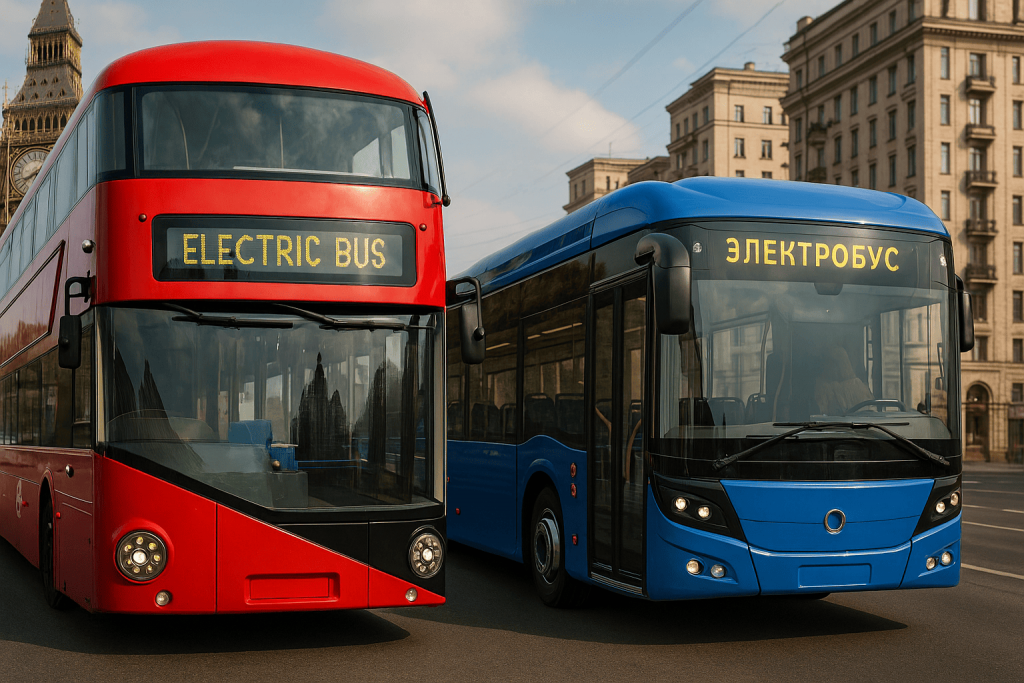
Across Europe’s busiest capitals, fleets of whisper-quiet electric buses are redefining what it means to ride the city streets. From the iconic double-deckers rolling past Big Ben to the sleek articulated vehicles gliding through Moscow’s historic boulevards, municipalities are embracing battery-powered transport as a cornerstone of their climate and public-health strategies. The shift is more than a technological upgrade—it is a social contract to deliver cleaner air, lower noise, and a more sustainable urban future.
London: A Zero-Emission Flagship
Transport for London (TfL) operates one of the world’s largest zero-emission bus fleets. More than 1,300 battery-electric buses now serve the city’s 700-plus routes, supported by rapid DC chargers installed at depots and on strategically located lay-bys. The result is a 5–10 decibel reduction in street-level noise and an estimated annual savings of 65,000 tons of CO₂. Crucially, nitrogen-oxide (NOₓ) emissions—linked to respiratory illness—have fallen sharply along corridors that once suffered chronic traffic pollution.
Moscow: Electrification at Scale
Moscow’s ambitious program rivals London’s in scope. Since 2018, the Russian capital has deployed more than 1,200 locally built e-buses equipped with lithium-titanate batteries that tolerate the region’s harsh winters. Fast-charge stations mounted at terminus stops replenish a bus in six to eight minutes, enabling 24-hour service without lengthy downtime. City officials report that particulate matter (PM2.5) near major avenues has declined by up to 20 percent, improving health outcomes for millions of residents.
Technology Driving the Transition
Modern e-buses rely on high-energy-density battery packs—typically 300–500 kWh—paired with regenerative braking systems that recover up to 30 percent of kinetic energy. Advanced thermal-management loops keep batteries within optimal temperature ranges, extending lifespan even in extreme climates. Overhead pantograph chargers and depot-based megawatt chargers work in tandem, allowing operators to tailor charging strategies to route length, layover time, and grid constraints.
Economic Benefits Beyond Fuel Savings
While electric buses carry a higher upfront cost than diesel counterparts, total cost of ownership is rapidly trending lower. Fuel savings can exceed €35,000 per vehicle per year, and simpler drivetrains reduce maintenance by as much as 40 percent. Local manufacturing in both the UK and Russia has stimulated job creation in battery assembly, software development, and charging-infrastructure construction—adding regional economic value to environmental gains.
Policy and Funding Catalysts
Government policy has been pivotal. London’s Ultra Low Emission Zone (ULEZ) imposes strict pollution charges, nudging operators toward zero-emission options. Moscow leverages federal green-transport subsidies and concessional loans that cover up to 60 percent of vehicle cost. Both cities benefit from power-grid upgrades and renewable-energy targets that ensure e-bus fleets are not merely shifting emissions upstream.
Challenges Remaining
Despite progress, obstacles persist. Peak-demand electricity tariffs can inflate operating costs, and depot space for chargers is limited in dense urban centers. Battery recycling and second-life applications remain works in progress, requiring robust circular-economy frameworks. Nonetheless, pilot projects in both cities are exploring vehicle-to-grid (V2G) technology, turning idle batteries into grid-balancing assets.
Conclusion
London and Moscow—two cities with vastly different climates, infrastructures, and political landscapes—demonstrate that large-scale electric-bus adoption is not only feasible but already delivering tangible environmental and economic benefits. As battery prices fall and charging technology matures, electric buses are poised to become the global standard for urban transit, driving cleaner air, quieter streets, and healthier communities from Europe’s western edge to its eastern heart.

electric buses r cool af 👍cant waittil we get that here