Electric vehicles are changing much more than personal transportation. Beyond electric cars, buses, and trucks, a growing category of specialized machines is beginning to automate tasks that previously required human drivers, conventional vehicles, or stationary industrial equipment. Autonomous parking carriers, robotic baggage transporters, electric yard tractors, and mobile delivery robots are bringing electric propulsion into increasingly specialized environments. Many of these machines are already operating in airports, logistics facilities, parking garages, and commercial buildings.
Among the most interesting developments are robotic parking carriers capable of lifting an entire passenger vehicle and transporting it without anyone behind the wheel. Other autonomous electric vehicles move aircraft baggage, reposition freight trailers, deliver groceries, or clean industrial facilities. The significance of these machines lies not simply in replacing combustion engines, but in combining electric mobility, robotics, and intelligent software to perform transportation tasks differently. Their advantages can be substantial, although real-world reliability, infrastructure requirements, safety, and operating costs remain important challenges.
What Are Robotic Parking Carriers?
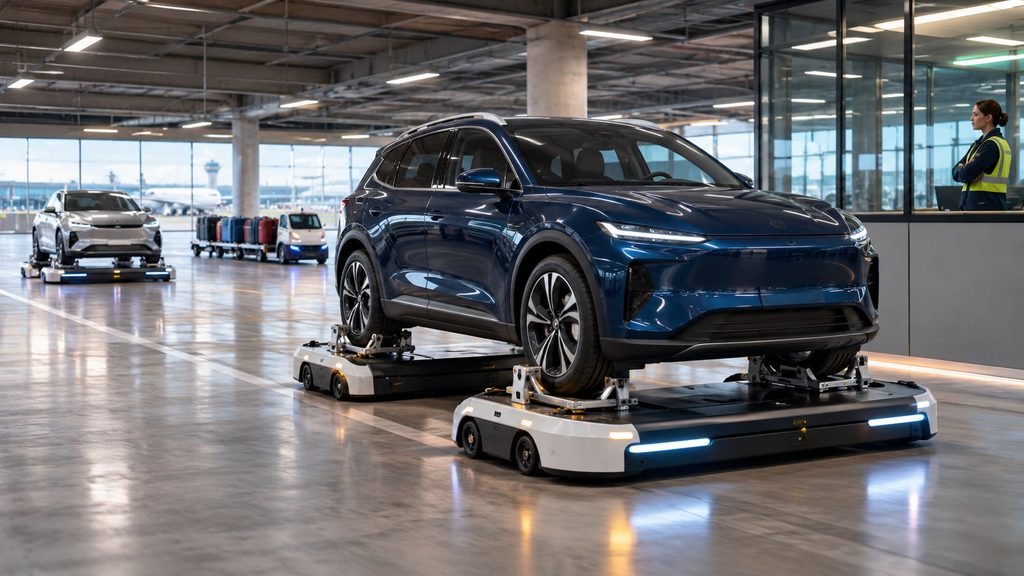
Robotic parking carriers are specialized autonomous electric platforms designed to transport vehicles within controlled parking environments. Rather than requiring a driver to maneuver into a parking space, these machines can approach a stationary car, lift it by its wheels, and move it to a designated location. Depending on the design, they use compact lifting mechanisms, electric drive motors, obstacle-detection sensors, and navigation software. Their relatively low profiles allow some models to travel underneath ordinary passenger vehicles.
The technology differs from conventional mechanical parking systems that rely on elevators, rails, or fixed platforms. Mobile parking robots can navigate across suitable existing surfaces, potentially allowing operators to automate parking without installing an entirely new multilevel mechanical structure. Vehicles can also be positioned more closely together in areas where customers are not permitted to walk between parked cars. The central advantage is that a car does not need to drive itself, or even be an electric vehicle, to participate in robotic valet parking.
How Autonomous Parking Robots Actually Work
A typical robotic valet parking process begins when a customer leaves a vehicle inside a designated drop-off area. The driver exits, confirms the handover, and allows the automated system to take responsibility for moving the car. Software identifies a suitable parking space and dispatches an available carrier, which positions itself beneath the vehicle and engages its lifting mechanism. Once the wheels are securely supported, the robot transports the vehicle to its assigned location.
The retrieval process reverses these steps when the owner requests the car. A central management platform coordinates vehicle locations, robot movements, charging schedules, and customer requests. Sensors help the robots identify obstacles and maintain positioning accuracy, while supervisory systems are designed to stop operations when an unsafe condition occurs. However, successful operation depends on compatible vehicle dimensions, suitable floor conditions, reliable communications, and appropriate procedures for unexpected situations.
Stanley Robotics: The Autonomous Parking Carrier Used at Airports
One of the best-known examples is Stan, an autonomous valet parking robot developed by Stanley Robotics in France. The system has been operating at Lyon Airport, where customers leave their vehicles in designated cabins rather than searching for parking spaces themselves. Stan approaches the vehicle, lifts it by its tires, and transports it to a managed parking area. This arrangement allows the operator to control the movement and positioning of parked vehicles without requiring customers to enter the storage area.
The airport project began operating in 2019 and initially included plans for approximately 500 automated parking spaces. By June 2026, Stanley Robotics reported that its Lyon service was serving more than 2,000 customers per month. This is a meaningful example of robotic parking progressing beyond exhibition prototypes into repeated commercial use. Nevertheless, the reported customer figure comes from the technology provider and should not be confused with an independent measurement of profitability or overall airport parking demand.
Stan also demonstrates why airports are attractive locations for automation. Travelers often leave their vehicles for several days, making high-density storage valuable and reducing the frequency with which individual cars must be moved. Operators can plan retrievals around expected customer demand and organize vehicles more efficiently. Robotic valet parking is particularly promising where large numbers of vehicles remain stationary for long periods.
PARKIE: An Ultra-Thin Robot That Can Move Heavy Cars
Another notable development is PARKIE, an autonomous parking robot developed by South Korea’s HL Robotics. The system uses exceptionally thin robotic platforms designed to move beneath parked vehicles and lift them through their wheel assemblies. According to the company, PARKIE is approximately 9 centimeters tall and can handle passenger vehicles weighing up to 3 metric tons. The system uses two coordinated robotic units to support and move the vehicle.
PARKIE attracted international attention after receiving a CES 2024 Best of Innovation award. During 2026, HL Robotics expanded its demonstrations at Gimpo International Airport in South Korea. A public trial of robotic valet parking began there on October 27, 2026, following earlier testing at the airport. This illustrates an important development: autonomous vehicle carriers are becoming practical mobility systems rather than existing only as futuristic engineering concepts.
However, the technology still requires careful integration with the surrounding parking infrastructure. Different vehicle wheelbases, ground clearances, tire dimensions, and total weights create engineering challenges. Robots also need sufficient space to approach vehicles safely, maneuver through operating areas, and avoid pedestrians or obstacles. An impressive lifting capacity does not automatically guarantee compatibility with every passenger car.
Robotic Carriers Versus Self-Parking Cars
Robotic parking carriers are not the same technology as automated valet parking systems built into vehicles. A parking carrier physically transports a stationary car, whereas an automated valet system can command a suitably equipped vehicle to drive itself through an approved parking facility. Both approaches can eliminate the need for a human driver to search for a parking space. However, their technical requirements and economic implications are quite different.
Bosch and Mercedes-Benz demonstrated the vehicle-based approach through their automated valet parking project at Stuttgart Airport. In 2022, the system received approval for commercial use in Germany as an SAE Level 4 driverless parking function. It relies on compatible vehicle technology and intelligent parking infrastructure rather than an independent robot lifting the car. Robotic carriers can potentially serve a much broader variety of existing vehicles, while self-parking systems depend on specific automotive and infrastructure capabilities.
Can Parking Robots Make Garages More Efficient?
The most attractive economic argument for robotic parking is improved use of available space. Conventional parking garages must accommodate vehicle turning movements, access routes, and enough clearance for occupants to enter and exit their cars. In a fully managed robotic storage area, some of these requirements may be reduced because cars are transported rather than driven into their final positions. Parking operators may therefore be able to accommodate additional vehicles within an appropriately designed facility.
However, capacity improvements should not be assumed without a detailed engineering study. Fire access, emergency evacuation provisions, building geometry, vehicle dimensions, and local safety regulations can restrict how closely cars may be stored. The number of robots also affects how quickly vehicles can be delivered during busy periods. A facility that stores more cars but produces long retrieval queues may deliver a disappointing customer experience.
Operators must balance space utilization against transport speed, robot availability, maintenance, and energy costs. Busy airports may experience concentrated retrieval demand when several flights arrive close together. Commercial garages face different patterns, including morning arrivals and evening departures. A successful robotic parking system must optimize both parking density and customer waiting time.
Autonomous Electric Baggage Vehicles at Airports
Parking carriers are only one category of specialized electric robots appearing at airports. Aurrigo, a British autonomous mobility company, has developed the Auto-DollyTug, an electric vehicle designed to transport aircraft baggage and cargo. Unlike a conventional baggage tractor, the machine combines towing capabilities with the ability to carry cargo directly. Its multidirectional movement allows it to approach equipment sideways and maneuver in restricted spaces.
According to Aurrigo’s published specifications, the Auto-DollyTug uses an 88-volt lithium-ion electrical system. It can carry one unit load device while towing up to four conventional baggage dollies or two cargo dollies, depending on the configuration. Amsterdam Airport Schiphol and KLM conducted trials involving autonomous baggage movements, with additional testing described in February 2025. The objective was to evaluate whether automated transport could improve baggage handling and reduce inefficient vehicle movements.
Professor David Keene, chief executive of Aurrigo, has described the Auto-DollyTug as one of the most significant innovations in baggage handling in more than four decades. His assessment represents an informed industry perspective rather than independent proof of economic performance. Actual benefits must still be demonstrated through operational data, including reliability, handling capacity, staffing requirements, and delays. Airport robotics can offer substantial potential, but controlled trials remain essential before large-scale deployment.
Autonomous Electric Yard Tractors for Freight Logistics
Freight yards are another environment where electric autonomous vehicles can perform repetitive transportation tasks. Conventional yard tractors move trailers between loading docks, storage positions, and distribution areas, often covering relatively short distances throughout the day. Outrider is developing autonomous yard operations using electric truck platforms designed for this specialized environment. Its system coordinates trailer movements and integrates vehicle navigation with yard management operations.
In October 2026, Outrider announced a strategic partnership with YMX Logistics intended to expand autonomous yard operations. The collaboration reflects growing commercial interest in automating trailer movements rather than relying entirely on manually operated diesel tractors. Electric propulsion is well suited to low-speed, repetitive movements because it provides precise torque control and eliminates tailpipe emissions during operation. Nevertheless, the system must handle complex tasks involving trailer connections, obstacle avoidance, changing yard conditions, and human workers.
Automation may reduce unnecessary vehicle idling and improve consistency, but the financial outcome depends on utilization rates and site requirements. Electric vehicles also need sufficient charging capacity and maintenance support. Unexpected trailer positions, damaged equipment, and temporary route obstructions can interrupt automated operations. Consequently, human supervision and clearly defined intervention procedures remain necessary.
Robotic EV Charging: When the Charger Comes to the Car
Autonomous electric mobility also creates opportunities for automating charging itself. Hyundai Motor Group has developed an Automatic Charging Robot designed to connect an EV charging cable to a vehicle without requiring the driver to insert the connector manually. The system uses camera-based artificial intelligence to identify the charging port and position the connector accurately. It must also account for variations in vehicle placement, charging port geometry, and cable positioning.
In May 2025, Hyundai Motor Group announced a partnership with Incheon International Airport to test and commercialize its robotic charging technology. Such systems could eventually complement automated valet parking, allowing a compatible electric vehicle to be parked and charged through coordinated robotic operations. The potential benefits include greater convenience and improved accessibility for drivers with limited mobility. However, these robots are specialized charging machines, not necessarily self-propelled vehicle carriers.
Automated charging also creates engineering challenges involving electrical safety, connector wear, weather protection, and communication between the vehicle and charging equipment. A robot must apply sufficient force to connect the plug without damaging the socket. It must also respond safely to communication failures or unexpected movement. Reliable automated charging requires coordination between robotics, electrical hardware, and vehicle software.
Robotic Battery Swapping Stations
Another auxiliary technology is automated battery swapping, which replaces a depleted electric vehicle battery with a charged one instead of requiring conventional plug-in charging. NIO has developed automated stations that coordinate vehicle positioning, battery removal, battery installation, and battery storage. The company’s fourth-generation Power Swap Station began operating in China in June 2024. Each station has space for 23 batteries and a stated theoretical capacity of up to 480 swaps per day.
Battery swapping differs from mobile utility vehicles because the robotic machinery is primarily installed inside a fixed facility. Nevertheless, it demonstrates how automated electric mobility infrastructure can become an integrated mechanical system. The technology may reduce the time drivers spend waiting for energy replenishment and allow batteries to be charged under managed conditions. Its main limitations include vehicle compatibility, battery standardization, infrastructure investment, and the substantial inventory of batteries required.
Small Electric Delivery Robots on Sidewalks
At the opposite end of the size spectrum are compact autonomous delivery robots. Starship Technologies operates small battery-powered machines that transport food and groceries over relatively short distances. These robots navigate sidewalks and pedestrian environments using cameras, other sensors, mapping technology, and remote assistance when necessary. Their low-speed operation makes them suitable for selected campuses, neighborhoods, and delivery areas.
In November 2025, Starship reported more than 9 million completed autonomous deliveries and a fleet exceeding 2,700 robots. These figures indicate that small electric delivery vehicles have reached meaningful commercial scale in some markets. However, practical limitations remain, including curb accessibility, pedestrian congestion, weather, battery capacity, and local permission requirements. Human assistance may still be needed when a robot encounters an unexpected situation it cannot safely resolve.
Autonomous Electric Cleaning and Maintenance Robots
Some of the most useful auxiliary electric vehicles perform work that passengers rarely notice. Tennant’s X4 ROVR is a compact autonomous floor-cleaning machine designed for commercial environments such as shopping centers, hospitals, and airports. The manufacturer specifies an estimated operating time of up to 2.5 hours under suitable conditions. Its autonomous operation can allow cleaning personnel to concentrate on other tasks while the machine covers planned routes.
Larger outdoor systems are also emerging. Finland’s Trombia has developed Trombia Free, an autonomous all-electric street-sweeping platform intended for industrial areas and controlled municipal environments. The manufacturer reports operation at a waste-processing facility in Kuopio, Finland. These machines show how electric automation extends beyond moving passengers or freight into cleaning, maintenance, and environmental services.
The electric drivetrain provides quiet operation and avoids local combustion exhaust, but it does not eliminate every environmental impact. Electricity generation, battery production, water consumption, replacement components, and maintenance all affect overall sustainability. Cleaning performance must also be assessed against conventional equipment rather than assumed to be superior. Electric automation is most valuable when it improves the entire operating process, not merely when it removes a human driver.
How Sensors and Artificial Intelligence Keep Utility Robots Moving
Most autonomous utility vehicles combine several technologies to understand their surroundings. Depending on the application, these may include lidar, cameras, ultrasonic sensors, wheel encoders, inertial measurement units, and positioning systems. Software processes the available information to estimate the robot’s location, recognize obstacles, and calculate a safe route. Electric motors then execute steering, propulsion, braking, and positioning commands.
Indoor parking garages present particular navigation challenges because satellite positioning may be unreliable or unavailable. Robots may therefore rely on mapping, lidar-based localization, visual references, or installed infrastructure. In busy environments, fleet management software must coordinate multiple machines to prevent conflicts and congestion. A robot that performs well alone may behave very differently when dozens of vehicles share the same operating area.
Artificial intelligence can improve perception and planning, but it does not remove the need for predictable safety behavior. Detection failures, damaged sensors, software faults, and unusual obstacles must be addressed through robust engineering. Safety-critical stopping functions should not depend solely on an AI model making the correct prediction. Reliable systems require testing, diagnostic monitoring, controlled operating boundaries, and appropriate fallback behavior.
Safety Standards and the Challenges of Real-World Deployment
Industrial autonomous vehicles operate under safety frameworks that differ from those governing passenger cars on public roads. ISO 3691-4:2023 addresses safety requirements and verification for driverless industrial trucks and their systems, including certain automated guided vehicles and autonomous mobile robots. However, whether a specific parking carrier, baggage transporter, or other robot falls within a particular standard depends on its design and intended use. Compliance therefore requires application-specific evaluation rather than assuming one certification covers every machine.
Parking robots introduce additional concerns because they may carry passenger cars weighing several tons. Lifting equipment must support the load securely, and the vehicle must remain stable during transport, turning, and emergency braking. Human access to automated movement zones must be controlled, and operators need procedures for collisions, mechanical failures, and emergency vehicle retrieval. Cybersecurity and communication reliability also become important when robot fleets depend on connected infrastructure.
The Financial and Environmental Reality of Robot Fleets
Although autonomous electric robots may reduce some operating expenses, their initial investment can be substantial. Costs may include specialized hardware, mapping, software licenses, charging stations, building modifications, insurance, cybersecurity measures, and staff training. Batteries, tires, sensors, lifting components, and drive systems also require replacement or servicing. A parking operator must therefore calculate total ownership costs rather than comparing robot electricity consumption with the fuel cost of conventional vehicles.
Electric systems produce no tailpipe emissions during operation, which can be especially valuable in enclosed garages and other areas where air quality is important. However, their total climate impact depends on electricity sources, vehicle manufacturing, battery life, and operating efficiency. A robot that spends long periods idle or requires frequent replacement may offer fewer environmental benefits than expected. High utilization, reliable maintenance, and efficient fleet scheduling are essential to making autonomous electric equipment economically and environmentally attractive.
Where Autonomous Utility Vehicles Make the Most Sense
The most promising environments share several characteristics: repetitive tasks, controlled routes, predictable operating conditions, and enough activity to justify the investment. Airports, distribution centers, industrial sites, and large parking facilities often meet these requirements better than unpredictable public streets. Robots can also be integrated gradually, allowing operators to test limited routes before expanding their coverage. This reduces operational risk and provides measurable evidence about performance.
The next major development is likely to involve coordination between several robotic systems rather than a single machine working independently. A parking carrier could transport a vehicle to a reserved location, an automated charging system could replenish its battery, and centralized software could schedule retrieval. Similar integration could connect autonomous baggage tractors, cargo-handling equipment, and airport logistics platforms. The technology required for individual tasks already exists, but making these systems cooperate reliably at scale remains a demanding engineering challenge.
Conclusion
Parking carriers and autonomous utility EV robots represent an important expansion of electric mobility beyond conventional road vehicles. Systems such as Stanley Robotics’ Stan and HL Robotics’ PARKIE demonstrate how passenger cars can be moved without drivers, while Aurrigo’s airport vehicles, Outrider’s yard automation, and other specialized machines address different transportation and maintenance tasks. Their common foundation combines electric propulsion with sensors, software, and controlled autonomous movement. These technologies are gradually changing how vehicles, goods, and equipment move through commercial environments.
Nevertheless, deployment requires more than technically impressive demonstrations. Safety certification, infrastructure compatibility, operating reliability, energy management, and financial performance determine whether robotic solutions are genuinely useful. Some applications are already commercially established, while others remain in trials or early deployment stages. The future of autonomous electric mobility may be shaped as much by these specialized working robots as by self-driving passenger cars.
Would you trust an autonomous robot to park your car, or would you prefer to keep control yourself? Share your opinion in the comments.