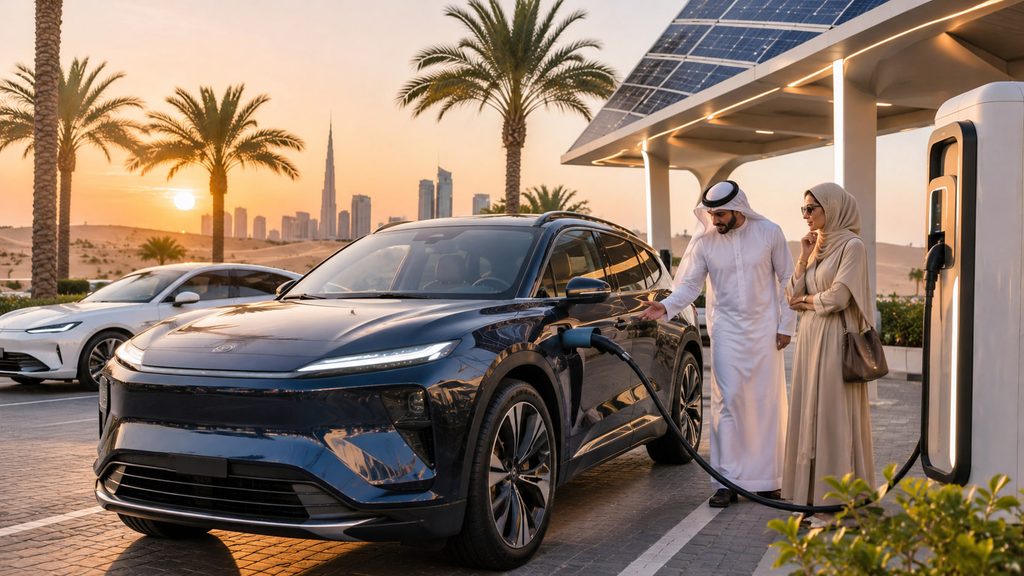
The United Arab Emirates and Saudi Arabia are among the world’s most influential oil-producing countries, yet both are investing in electric vehicles, charging infrastructure, and advanced automotive technology. At first glance, their growing interest in battery-powered transportation may seem contradictory because petroleum exports have contributed enormously to their economic development. However, electric mobility is becoming part of broader strategies involving industrial diversification, technological innovation, and the modernization of transportation. These ambitions demonstrate that even major oil exporters are preparing for changes in the global automotive industry.
The two countries are approaching the electric vehicle transition from different starting points. The UAE is developing a growing consumer market supported by charging infrastructure in cities and along important highways. Saudi Arabia is pursuing a more extensive industrial strategy that includes domestic automotive manufacturing, international partnerships, and investment in charging networks. Their experiences demonstrate that electric mobility is not simply an environmental initiative but also an economic and technological opportunity.
Why Oil-Rich Countries Are Investing in Electric Vehicles
The economic importance of petroleum does not prevent oil-producing nations from investing in alternative transportation technologies. Governments must consider future industrial competitiveness, domestic energy consumption, employment opportunities, and technological development. Electric vehicles create demand for batteries, power electronics, charging equipment, software, and specialized engineering services. These industries can support economic diversification even while petroleum production remains important.
There is also a distinction between exporting oil and using gasoline in domestic transportation. A country may continue selling petroleum internationally while encouraging more efficient or electric vehicles within its borders. This does not eliminate the environmental impact of exported fossil fuels, but it can change local energy consumption and transportation emissions. The UAE and Saudi Arabia are investing in electric mobility as part of longer-term economic strategies rather than preparing to abandon oil production immediately.
How Quickly Is the Middle Eastern EV Market Growing?
The Middle Eastern electric vehicle market remains relatively small compared with China and Europe, but recent growth has been substantial. According to the International Energy Agency’s Global EV Outlook 2026, regional electric car sales reached approximately 75,000 vehicles in 2025. That represented growth of more than 40% compared with the previous year. The figures include battery-electric and plug-in hybrid passenger cars, rather than only vehicles powered exclusively by batteries.
The UAE accounted for almost half of regional electric car sales, making it the largest market in the Middle East under the IEA’s classification. Saudi Arabia and Qatar together represented nearly 45% of regional demand, demonstrating increasing adoption beyond the Emirates. However, these figures should not be interpreted as proof that electric vehicles dominate the region’s new-car market. The Middle East is experiencing accelerating EV adoption while remaining at a comparatively early stage of its transition.
The UAE’s Long-Term Electric Vehicle Strategy
The UAE has established national objectives intended to encourage cleaner transportation and support charging infrastructure. In 2023, the federal government announced a national electric vehicle policy designed to improve charging standardization and encourage public and private investment. The strategy includes an ambition for electric vehicles to account for 50% of vehicles on UAE roads by 2050. This is a long-term fleet objective rather than a claim about current electric vehicle market share.
Achieving such a target requires considerably more than increasing new-car sales. Vehicles purchased today may remain on the road for many years, while the country must also accommodate population growth and changing transportation requirements. Charging access, affordable vehicle models, and dependable maintenance services will therefore influence the pace of replacement. A successful transition will require electric vehicles to become practical for ordinary households rather than remaining concentrated among premium-car buyers.
Dubai Has Become an Important EV Market
Dubai has emerged as one of the region’s most active centers of electric vehicle adoption. The Dubai Electricity and Water Authority, commonly known as DEWA, launched its EV Green Charger initiative in 2014 to encourage charging infrastructure development. The network has since expanded through utility investment and cooperation with private operators. By the end of 2025, Dubai had 47,944 registered electric vehicles, compared with 37,486 at the end of the previous year.
This represented annual growth of approximately 27.9%, demonstrating a sustained increase in the number of electric cars using the city’s roads. DEWA also reported more than 1,860 charging points across the emirate by early 2026, including infrastructure developed through licensed partners. These numbers indicate progress, although charging points should not be confused with complete charging stations or geographical locations. Dubai’s experience illustrates how consistent infrastructure investment can support consumer confidence and encourage broader electric vehicle adoption.
Abu Dhabi Is Expanding Public Charging Access
Abu Dhabi is pursuing a coordinated approach to electric mobility through public infrastructure programs and partnerships with private operators. Charging access is particularly important because the emirate includes dense urban districts, developing suburban areas, and communities separated by substantial distances. In November 2026, Abu Dhabi Mobility announced the activation of 244 charging units providing 332 charging points in public parking areas. The project covers selected locations across Abu Dhabi City, Al Ain, and the Al Dhafra region.
The wider program includes plans for more than 9,000 charging points across approximately 2,250 locations by 2032. These figures represent development targets rather than infrastructure that has already been completed. The network combines different charging speeds to accommodate both longer parking periods and faster energy replenishment. The practical success of Abu Dhabi’s investment will depend on charger reliability, convenient payment systems, and accessible locations.
Oil Companies Are Entering the Charging Business
One of the most revealing developments in the UAE is the participation of conventional petroleum companies in electric vehicle infrastructure. ADNOC Distribution, traditionally associated with fuel retailing, has begun expanding its charging services as part of a broader mobility strategy. In January 2026, the company opened a large EV charging complex at Saih Shuaib on the E11 highway between Abu Dhabi and Dubai. The facility provides 60 high-speed charging points and is designed to support drivers traveling along one of the country’s busiest transport corridors.
ADNOC Distribution also outlined plans to establish 20 highway charging hubs by the end of 2027. The company can use its existing roadside experience, commercial locations, and customer relationships to support this expansion. However, charging facilities require different electrical infrastructure and operating arrangements from traditional fuel pumps. The involvement of major petroleum retailers demonstrates that established energy businesses are adapting to changes in vehicle technology.
Saudi Arabia Wants to Build an Automotive Industry
Saudi Arabia’s electric vehicle strategy extends beyond encouraging consumers to purchase imported cars. The country is attempting to establish a competitive automotive manufacturing sector as part of Vision 2030 and its broader economic diversification agenda. Producing vehicles creates opportunities in engineering, electronics, logistics, manufacturing equipment, and specialized industrial services. It may also encourage international suppliers to establish facilities near automotive assembly plants.
However, creating a successful automotive industry requires much more than constructing factories. Manufacturers need reliable component suppliers, experienced engineers, efficient production systems, and products that can compete internationally. A factory’s announced production capacity does not guarantee that customer demand will support full utilization. Saudi Arabia’s ambition will ultimately be measured by commercially successful production rather than the size of its investment announcements.
Ceer Is Developing Saudi-Branded Electric Cars
Ceer is one of Saudi Arabia’s most prominent automotive projects. The company was established in 2022 through a partnership involving the Public Investment Fund and Foxconn, with additional technology and engineering support from international partners. Its objective is to develop vehicles for Saudi Arabia and other markets while establishing domestic manufacturing capabilities. The project reflects the country’s intention to participate directly in automotive design and production.
On September 21, 2026, Ceer officially revealed its first flagship vehicles, the EXOBOT electric sedan and SUV. The models are planned for production at the company’s manufacturing complex in King Abdullah Economic City, with initial Saudi sales targeted for 2027. Additional vehicles are planned for later years, although future releases remain dependent on manufacturing progress and commercial conditions. The EXOBOT unveiling is an important industrial milestone, but sustained production and customer satisfaction will determine whether Ceer becomes a successful automotive brand.
Lucid Motors Is Another Major Saudi Investment
Lucid Motors occupies an important position in Saudi Arabia’s efforts to establish an electric vehicle manufacturing ecosystem. The American EV manufacturer opened its AMP-2 facility in King Abdullah Economic City in September 2023. Its initial activities involved reassembling vehicles from kits manufactured partly in the United States. This arrangement provided an early manufacturing presence while the company prepared for more comprehensive production operations.
According to Lucid’s September 2026 regulatory filing, the company expects to begin manufacturing complete vehicles at the Saudi facility in 2027. The distinction between vehicle reassembly and complete production is important because the two activities require different industrial capabilities. Full manufacturing involves more extensive equipment, operational planning, and supplier coordination. Lucid’s expansion could contribute valuable expertise, but its long-term success will depend on production efficiency, financial sustainability, and consumer demand.
Saudi Arabia Needs a Nationwide Charging Network
Saudi Arabia’s geographical scale creates significant challenges for electric vehicle adoption. Riyadh, Jeddah, Dammam, and other major population centers are separated by long highway distances, often through sparsely populated desert regions. Drivers considering an electric vehicle must therefore assess not only city charging availability but also the reliability of stations along intercity routes. Without dependable charging coverage, long-distance travel can become inconvenient even for modern vehicles with substantial battery capacity.
The Electric Vehicle Infrastructure Company, known as EVIQ, was established in 2023 through a partnership between the Public Investment Fund and Saudi Electricity Company. Its strategy includes installing more than 5,000 fast chargers across approximately 1,000 locations by 2030. The network is intended to support electric mobility in cities and along major transport corridors. Achieving extensive geographical coverage will be essential if electric cars are to become practical beyond a relatively small group of urban early adopters.
Why Charging Infrastructure Must Be Reliable
Charging network performance depends on much more than the number of installed connectors. Drivers need stations that operate consistently, accept convenient payments, and provide accurate information about availability. In hot climates, equipment must also withstand demanding temperatures and sustained electrical loads. Charging locations along major highways should ideally provide safe access, lighting, rest facilities, and appropriate maintenance support.
Fast-charging performance varies depending on the vehicle and battery conditions. A charger advertised at 350 kW will not necessarily supply that power to every compatible car, particularly when battery temperatures or charge levels limit energy acceptance. Drivers should therefore compare realistic charging times rather than focusing exclusively on equipment ratings. A smaller network of dependable chargers can provide greater practical value than a larger network with frequent technical problems.
Can Electric Cars Handle Extreme Desert Heat?
Summer heat is one of the most distinctive technical challenges facing electric vehicles in the Gulf region. Temperatures frequently exceed 40 degrees Celsius in parts of the UAE and Saudi Arabia, increasing demand for cabin cooling and battery thermal management. Lithium-ion batteries are designed to operate within controlled temperature ranges, and prolonged exposure to excessive heat can accelerate degradation. High temperatures can also influence charging speed and the amount of energy available for driving.
Research published in Applied Energy in 2025 examined hundreds of thousands of trips made by electric vehicles in the Phoenix metropolitan area. The researchers found that energy consumption increased by approximately 25% to 28% when temperatures rose from around 26-30 degrees Celsius to 46-50 degrees Celsius in the studied conditions. These results are useful for understanding heat-related energy demands, although they should not be applied as a fixed percentage to every vehicle in the Middle East. Electric cars can operate successfully in desert climates, but effective cooling systems and realistic range planning are particularly important.
Battery Cooling and Parking Conditions Matter
Modern electric vehicles commonly use thermal management systems designed to regulate battery temperature during driving and charging. Liquid cooling can help maintain suitable operating conditions and protect performance when external temperatures become demanding. However, these systems require energy, and their effectiveness varies according to vehicle design and battery chemistry. Repeated exposure to severe heat may also influence long-term battery aging.
Drivers can reduce some unnecessary thermal stress by using shaded parking when available and following manufacturer recommendations for charging and battery care. Cabin preconditioning while connected to external power may help reduce the initial energy demand placed on the battery. Owners should also investigate battery warranty terms and service availability before selecting a vehicle for prolonged desert use. Thermal management quality is an essential ownership consideration rather than a minor technical specification in Gulf markets.
Are Electric Cars Cheaper Than Gasoline Vehicles?
Electric vehicles can offer lower energy costs per kilometer because electric motors generally convert stored energy into movement more efficiently than combustion engines. Consider an illustrative EV consuming 18 kWh per 100 kilometers and a gasoline car consuming 8 liters over the same distance. At an assumed electricity price of AED 0.40 per kWh, the electric vehicle would use approximately AED 7.20 of electricity before charging losses. At an assumed gasoline price of AED 2.50 per liter, the conventional car would require approximately AED 20 of fuel.
These figures are hypothetical examples rather than guaranteed current UAE prices. Actual charging costs vary according to residential tariffs, commercial operators, location, and charging speed. Insurance, financing, tire replacement, depreciation, and maintenance also influence total ownership costs. Electric driving can offer financial benefits even in petroleum-producing countries, but a complete comparison requires more than fuel expenses alone.
Electricity Generation Shapes Environmental Benefits
Battery-electric vehicles produce no exhaust emissions during normal driving, but their overall environmental performance depends partly on how electricity is generated. The UAE has invested in nuclear power and solar energy alongside its existing conventional electricity infrastructure. The Barakah nuclear power plant has become an important source of low-carbon electricity, while solar projects continue contributing to energy diversification. These investments can improve the emissions profile of electric vehicle charging over time.
Saudi Arabia is also developing renewable energy projects, although fossil fuels remain important to its electricity system. Battery manufacturing, raw material extraction, and vehicle production create additional environmental impacts that should be considered in life-cycle assessments. Nevertheless, electric powertrains are generally more energy-efficient than combustion engines, and their environmental performance can improve as electricity generation becomes cleaner. The greatest long-term climate benefits will emerge when vehicle electrification is combined with lower-emission electricity production.
Chinese Manufacturers Are Changing the Market
Chinese automakers have become increasingly influential in the Middle Eastern electric vehicle market. Companies such as BYD and other manufacturers offer electric sedans, SUVs, and plug-in hybrid vehicles across several price categories. Their growing presence has expanded consumer choice and increased competition with established American, European, Japanese, and South Korean brands. Competitive vehicle pricing and improving technology are important factors behind this expansion.
The International Energy Agency reported that BYD accounted for approximately 60% of Middle Eastern electric car sales in 2025, compared with around 15% for Tesla. These are regional figures, not separate market shares for the UAE or Saudi Arabia. They illustrate how quickly market leadership can change as manufacturers enter new regions and develop distribution networks. Greater competition could make electric vehicles more accessible, although buyers must still evaluate warranty coverage, service quality, and long-term parts availability.
What Industry Experts Say About the Transition
The International Energy Agency provides an important perspective on the development of electric vehicle markets outside the traditional centers of China, Europe, and North America. Its Global EV Outlook 2026 documents substantial Middle Eastern sales growth while showing that regional demand remains concentrated in a relatively small number of countries. The assessment also highlights the increasing importance of Chinese manufacturers and the changing competitive structure of the market. These findings suggest that infrastructure development and affordable vehicle availability could become decisive factors in future adoption.
Saudi Arabia’s industrial ambitions offer another perspective on the transition. During the September 2026 unveiling of Ceer’s first vehicles, chief executive Jim DeLuca emphasized the importance of demonstrating the country’s automotive capabilities. However, the company’s ambitions still need to be tested through manufacturing operations and commercial sales. Expert and industry assessments support the market’s growth potential while making clear that announced plans should not be confused with completed achievements.
The Biggest Obstacles to Wider EV Adoption
Electric vehicle adoption in the Gulf faces several important practical barriers. Purchase prices remain relatively high for certain models, while some apartment residents have limited access to convenient private charging. Public infrastructure is expanding, but coverage and reliability vary considerably outside major urban centers. Extreme heat also increases cooling requirements and makes battery durability an important consumer concern.
Economic conditions create additional considerations because conventional fuel infrastructure is already well established. Gasoline vehicles offer familiar refueling procedures, extensive service networks, and a broad range of models. Domestic manufacturing projects must also compete against experienced international producers with established supply chains. For electric vehicles to become mainstream, they must offer dependable ownership experiences and competitive overall costs rather than relying primarily on government support.
What to Expect From Electric Cars in the Gulf by 2030
The next several years could bring substantial progress in both electric vehicle adoption and regional automotive manufacturing. In the UAE, expanding charging networks and greater model availability are likely to support continued consumer interest. Saudi Arabia’s development will depend more heavily on the success of local manufacturing projects and nationwide infrastructure investment. Companies such as Ceer, Lucid, EVIQ, and ADNOC Distribution will influence how these plans translate into practical services.
However, infrastructure and production targets remain projections until the relevant facilities and services are operating. Changes in vehicle prices, electricity tariffs, economic conditions, and consumer preferences could affect the pace of adoption. Competition may also intensify as established manufacturers and emerging brands introduce additional models. The clearest measure of success will be whether ordinary drivers can purchase, charge, maintain, and resell electric vehicles with confidence.
Conclusion
The UAE and Saudi Arabia demonstrate that electric mobility is becoming an important investment area even in economies historically associated with petroleum production. The UAE has focused heavily on consumer adoption and charging infrastructure, while Saudi Arabia is pursuing a broader industrial strategy involving domestic automotive manufacturing. Both approaches offer opportunities for economic diversification, technological development, and more efficient transportation. However, neither country has completed its transition, and conventional vehicles remain important to daily mobility.
Future progress will depend on reliable charging infrastructure, affordable vehicles, effective battery cooling, and competitive service networks. Saudi Arabia must also turn industrial investment into sustainable manufacturing operations, while the Emirates must continue extending charging accessibility beyond major urban areas. The experience of both countries shows that the shift toward electric vehicles can coexist with significant petroleum industries, even as broader environmental questions remain unresolved. The future of electric cars in these oil-rich nations will ultimately depend on making electric mobility economically sensible and practically convenient for everyday drivers.
Do you think the UAE and Saudi Arabia can become global leaders in electric mobility, or will oil-based transportation remain dominant for decades? Share your opinion in the comments.