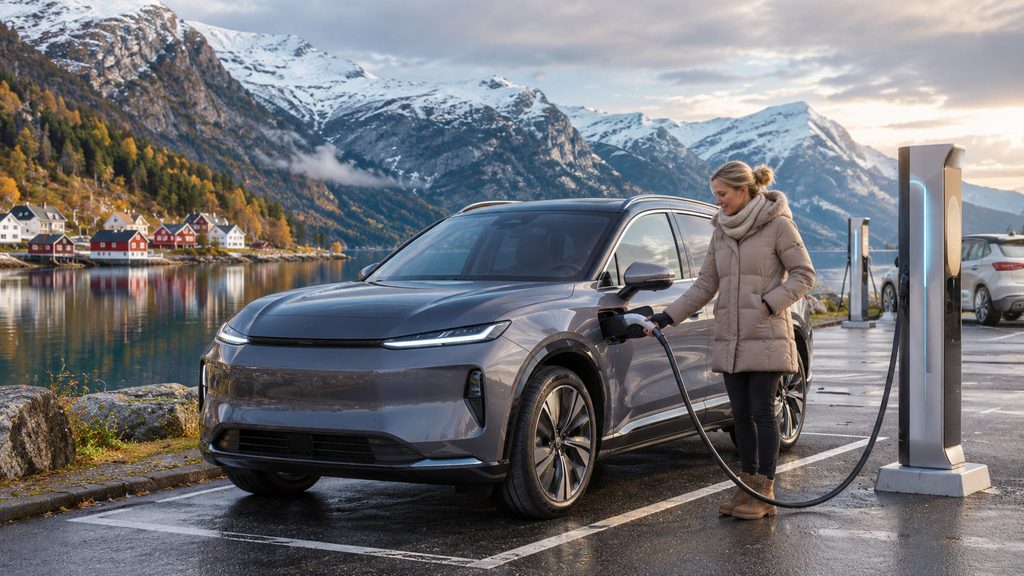
Norway has achieved something that seemed almost impossible just two decades ago: turning electric vehicles from a niche alternative into the dominant choice for new-car buyers. While many countries continue debating the future of gasoline and diesel engines, Norway has already transformed its passenger car market. Electric cars are now an ordinary part of everyday life, from the streets of Oslo to remote communities surrounded by mountains and fjords.
The numbers illustrate the scale of this transformation. According to the Norwegian Road Federation, fully electric vehicles accounted for 95.9% of new passenger car registrations in 2025, compared with 88.9% in 2024. By October 2026, that figure had reached 98.8% for the month, with electric cars representing approximately 98% of registrations during the first ten months of the year.
Norway’s electric vehicle revolution did not happen simply because drivers became more environmentally conscious. It resulted from decades of consistent government policies, financial incentives, infrastructure investment, and changing consumer expectations. Understanding how these factors worked together reveals why Norway became the world’s leading electric vehicle market and what other countries can learn from its experience.
Norway’s Electric Vehicle Revolution in Numbers
Norway’s leadership becomes particularly impressive when considering how quickly the country’s automotive market has changed. In the early 2010s, electric cars represented only a small percentage of new registrations. By the end of the decade, they were competing directly with conventional vehicles, and by the middle of the 2020s, combustion-engine cars had become a small minority of new purchases.
The Norwegian EV Association reported that battery-electric vehicles captured 95.9% of the new passenger car market in 2025. The trend continued into 2026, when 15,536 of the 15,725 passenger cars registered in October were fully electric.
However, new-car registrations tell only part of the story. On October 31, 2026, Norway had approximately 1.06 million registered electric passenger cars, representing 36.1% of the country’s total passenger car fleet. Electric vehicles had become the largest individual powertrain category, ahead of diesel and gasoline.
This distinction matters: Norway has nearly completed the transition in new passenger car sales, but replacing the existing vehicle fleet will take considerably longer.
How Norway Started Supporting Electric Cars
Norway’s electric vehicle strategy began long before modern EVs became commercially attractive. During the 1990s, electric cars typically offered limited driving range, small batteries, and relatively basic performance. Nevertheless, Norwegian policymakers introduced measures designed to encourage early adoption and support technological development.
In 1990, Norway introduced an exemption from purchase and import taxes for electric vehicles. Additional advantages followed, including reduced ownership taxes and exemptions from certain road tolls. In 2001, electric cars became exempt from the country’s standard 25% value-added tax.
These policies significantly improved the economics of owning an electric vehicle. Although early models remained technologically limited, their lower tax burden helped compensate for higher purchase costs.
The timing was important because Norway established its support framework before manufacturers offered a broad range of competitive electric cars. When modern models eventually arrived, the country already had favorable market conditions and consumers who were increasingly familiar with electric mobility.
Tax Incentives Changed the Economics of Car Ownership
One of the most important reasons for Norway’s success is its automotive taxation system. Rather than relying exclusively on direct subsidies for electric vehicles, the country made high-emission cars comparatively expensive through taxes related to vehicle weight and emissions.
For conventional cars, Norway’s registration tax has historically considered factors such as carbon dioxide and nitrogen oxide emissions. This can substantially increase the purchase price of powerful gasoline and diesel vehicles.
Electric cars, meanwhile, benefited from major exemptions. For many years, buyers avoided both the conventional registration tax and the standard 25% VAT. The difference could amount to tens of thousands of Norwegian kroner, making EVs financially competitive even when their manufacturing costs were higher.
The Norwegian EV Association describes this approach through the polluter-pays principle, in which higher-emission vehicles face greater taxation while cleaner alternatives receive more favorable treatment.
This strategy offers an important lesson: consumers do not necessarily need large direct cash subsidies to adopt electric vehicles. A carefully structured tax system can influence purchasing decisions by changing the relative costs of competing technologies.
Everyday Benefits Made Electric Cars More Attractive
Purchase incentives were only one part of Norway’s early strategy. The government also introduced advantages that made electric cars more convenient and economical to use.
Over time, these benefits included:
- Exemptions or discounts on road tolls
- Reduced ferry fares
- Free municipal parking during earlier incentive periods
- Access to selected bus lanes
- Lower annual vehicle taxes
- Favorable treatment for certain company vehicles
For commuters traveling into major cities, toll exemptions and bus-lane access could provide significant benefits. Lower ferry charges were particularly relevant in a country where coastal geography makes ferries an important part of transportation.
Many of these privileges have subsequently been reduced or modified. Local authorities can restrict bus-lane access, and electric vehicles are no longer universally exempt from road tolls.
The key achievement was making electric vehicles attractive during their early adoption period, when the technology still required consumers to accept compromises.
The Importance of Norway’s 2025 Zero-Emission Target
Norway established a national ambition that all new passenger cars and light vans should be zero-emission vehicles by 2025. The passenger car target created a clear signal for manufacturers, importers, charging companies, and consumers.
Unlike a sudden prohibition on conventional cars, the strategy relied heavily on financial incentives, taxation, and market development. Buyers retained access to different powertrains, but the economic environment increasingly favored zero-emission alternatives.
Although Norway did not achieve a literal 100% electric share in 2025, the 95.9% result meant the passenger car objective was effectively reached in practical terms.
The target also encouraged automakers to prioritize Norway when introducing new electric models. As demand increased, dealerships expanded their EV offerings, technicians developed relevant expertise, and consumers gained access to more competitive vehicles.
Charging Infrastructure Removed a Major Barrier
A successful electric vehicle market requires more than affordable cars. Drivers must also feel confident that charging will be available when needed, particularly during longer journeys.
Norway invested in public charging infrastructure while encouraging private charging at homes and workplaces. Fast-charging facilities gradually expanded along major highways and important regional transport routes.
By mid-2026, the Norwegian EV Association reported enough public fast-charging capacity for nearly 11,000 cars to charge simultaneously. This extensive network helped reduce range anxiety and made long-distance electric travel considerably more practical.
Home charging remains especially important. Norway has a substantial number of households with access to private parking, allowing many EV owners to recharge overnight. For these drivers, everyday charging can be more convenient than visiting conventional fuel stations.
However, apartment residents and households without dedicated parking face different challenges. Norway responded partly through legislation establishing charging rights for people living in apartment buildings between 2017 and 2021.
Norway’s experience demonstrates that reliable charging access is essential to EV adoption, but home charging and public fast charging serve different needs.
Hydropower Gives Norway an Environmental Advantage
Norway possesses another important advantage: an electricity system dominated by renewable energy.
According to Statistics Norway, the country generated approximately 161.8 terawatt-hours of electricity in 2025. Hydropower supplied about 89.9% of total generation, while wind power contributed approximately 8.6%.
This energy mix makes electric vehicles particularly attractive from an emissions perspective. Battery-electric cars produce no exhaust emissions while driving, and Norway’s low-carbon electricity reduces the emissions associated with charging.
The environmental benefits are not completely impact-free. Battery manufacturing requires energy and raw materials, while tire wear, vehicle production, and infrastructure development create additional environmental pressures.
Nevertheless, the combination of efficient electric powertrains and renewable electricity gives Norway favorable conditions for reducing road transport emissions.
There is also an important distinction between producing renewable electricity and having inexpensive electricity. Norwegian electricity prices fluctuate with hydropower conditions, regional demand, and energy market developments, so charging costs are not uniformly low.
Why Norwegian Drivers Embraced Electric Cars
Government policy initially created demand, but improvements in vehicle technology helped electric cars become mainstream.
Early models such as the Nissan Leaf demonstrated that electric mobility could work for everyday commuting. Later, vehicles including the Tesla Model S, Tesla Model 3, Tesla Model Y, and Volkswagen ID.4 expanded consumer expectations around range, performance, comfort, and practicality.
By 2025, the Tesla Model Y had become Norway’s best-selling new passenger car, recording 27,621 registrations during the year. Other popular models included the Volkswagen ID.4, Toyota bZ4X, Volkswagen ID.7, and Tesla Model 3.
The growing availability of electric SUVs and family vehicles was particularly important. Norwegian drivers frequently need cars capable of carrying passengers, luggage, sports equipment, and winter accessories.
Modern EVs increasingly meet these requirements while offering smooth acceleration, quiet operation, and reduced routine powertrain maintenance.
As electric vehicle technology improved, Norwegian consumers no longer needed to choose between environmental considerations and the practicality of a conventional family car.
Can Electric Cars Handle Norway’s Harsh Winters?
Norway’s climate provides a demanding environment for battery-electric vehicles. Winter temperatures, snow-covered roads, mountainous terrain, and long distances between communities can reduce efficiency and complicate travel.
Cold weather increases energy consumption because batteries operate less efficiently at low temperatures and vehicles require energy for cabin heating and battery temperature management. Snow, winter tires, and unfavorable road conditions can increase consumption further.
Actual range reduction depends on the vehicle, temperature, journey length, and heating system. Short winter journeys can be particularly energy-intensive because the cabin and battery may require repeated warming.
Modern electric vehicles address some of these challenges through heat pumps, battery preconditioning, improved thermal management, and navigation systems that prepare the battery before fast charging.
Still, Norway’s experience does not suggest that winter driving limitations have disappeared. Drivers must plan charging stops carefully, especially when traveling through remote regions or during severe weather.
The practical lesson is that electric vehicles can operate successfully in cold climates when suitable technology, dependable charging infrastructure, and realistic range expectations are combined.
Competition Helped Accelerate the EV Transition
Norway’s favorable market conditions attracted a broad range of international manufacturers. European, American, South Korean, Japanese, and Chinese companies increasingly competed for Norwegian customers.
This competition expanded vehicle choice across different prices, body styles, and driving requirements. Electric SUVs became particularly popular, while improvements in battery efficiency and manufacturing scale made more affordable models possible.
By October 2026, Chinese automotive brands accounted for 22.5% of Norway’s new passenger car registrations during that month, according to the Norwegian Road Federation. Brands such as BYD and XPeng had become visible competitors alongside established manufacturers.
At the same time, Norway’s electric vehicle market has become increasingly mature. Manufacturers can no longer rely solely on the novelty of battery-powered driving to attract buyers.
Instead, customers compare familiar automotive qualities such as price, cabin space, winter performance, warranty coverage, software reliability, and charging speed.
The Remaining Challenge: Replacing Older Cars
Norway’s remarkable new-car statistics can create the impression that nearly every vehicle on its roads is electric. The actual situation is more complicated.
Although battery-electric cars represented approximately 98% of new passenger car registrations during January through October 2026, they accounted for only 36.1% of the existing passenger car fleet at the end of October.
This reflects the long service life of vehicles. Cars purchased ten or fifteen years earlier can remain on the road well after new-car preferences have changed.
Geir Inge Stokke, managing director of the Norwegian Road Federation, emphasized this distinction when discussing the October 2026 registration figures. He noted that almost two-thirds of the country’s passenger cars were still not electric and that replacing older vehicles remained necessary to reduce road transport emissions.
His assessment highlights an important limitation of sales-based targets. Transforming the market for new cars is only the first stage of reducing emissions from the entire vehicle fleet.
Used electric vehicles, affordable repairs, battery longevity, and accessible charging will become increasingly important as Norway moves into the next phase.
Why Norway Is Gradually Reducing EV Incentives
A major question facing Norwegian policymakers is how to manage a mature electric vehicle market without maintaining expensive tax advantages indefinitely.
In 2023, Norway began applying its 25% VAT to the portion of an electric car’s purchase price exceeding NOK 500,000. In 2026, the tax-free threshold was reduced to NOK 300,000.
For example, under the 2026 rules, an electric vehicle with a pre-VAT price of NOK 500,000 incurs NOK 50,000 in VAT on the amount above the threshold, before accounting for any other applicable charges.
In its proposed 2027 budget, the Norwegian government has outlined a further reduction of the VAT exemption threshold to NOK 150,000, with the intention of eventually removing the exemption entirely. As of November 2026, the 2027 change remains a budget proposal rather than a completed policy outcome.
Reducing incentives can improve government revenue, but it also carries potential risks. Higher purchase prices may affect lower-income households, while manufacturers and dealerships must adjust their pricing strategies.
Norway therefore faces a new challenge: maintaining strong demand for electric cars while gradually moving toward a more conventional taxation system.
The Limitations of Norway’s Electric Vehicle Model
Norway’s success is impressive, but its approach cannot be reproduced identically in every country.
First, Norway has a relatively small, wealthy population and substantial public financial resources. Its economic circumstances made prolonged tax incentives easier to sustain than they might be in countries with tighter government budgets.
Second, the country benefits from abundant renewable electricity and widespread residential charging opportunities. Nations with less developed electrical grids, expensive electricity, or large populations living without private parking face additional obstacles.
Third, the transition creates distributional concerns. Households that can afford new electric cars and install home chargers may benefit more readily from incentives than people who depend on older vehicles.
Norway also remains a major exporter of oil and natural gas. Its success in electrifying domestic passenger transport therefore exists alongside a substantial fossil-fuel industry, illustrating the distinction between reducing national transport emissions and transforming the broader energy economy.
Finally, electric vehicles do not eliminate road congestion, tire-related particulate pollution, parking demand, or the environmental impacts of manufacturing automobiles.
Electrification can significantly reduce transportation emissions, but it is not a complete substitute for efficient public transport, urban planning, and sustainable mobility policies.
What Other Countries Can Learn From Norway
Norway’s experience offers valuable lessons for governments attempting to accelerate electric vehicle adoption. The most important is that successful transitions depend on long-term consistency rather than short-lived promotional programs.
Financial incentives helped establish the market, but charging infrastructure, model availability, public confidence, and supportive regulations were equally important. Each element reinforced the others as adoption increased.
Other countries can adapt this strategy by developing predictable vehicle taxation, expanding reliable charging networks, supporting apartment residents, encouraging competition, and maintaining clear long-term emissions objectives.
However, financial policies should reflect local economic conditions. Direct purchase incentives may work in some markets, while emissions-based taxes, affordable financing, or infrastructure investment may be more effective elsewhere.
Governments should also avoid assuming that impressive new-car registration figures automatically translate into rapid reductions in total fleet emissions. Policies addressing used vehicles, commercial transport, electricity generation, and vehicle longevity remain essential.
Norway’s central achievement is demonstrating that electric cars can become the default consumer choice when economic incentives, practical convenience, and technological progress align.
Conclusion
Norway became the world’s leading electric vehicle market through a combination of forward-looking policies, favorable taxation, renewable electricity, expanding charging infrastructure, and strong consumer adoption. Its transformation was gradual, beginning with incentives introduced decades before electric cars became technologically competitive.
By 2025, fully electric vehicles accounted for 95.9% of new passenger car registrations, and their share approached 98% during the first ten months of 2026. These figures demonstrate how quickly an automotive market can change when supportive policies remain in place long enough for technology and infrastructure to mature.
Nevertheless, Norway’s transition is not complete. Most vehicles in the existing passenger car fleet still use other powertrains, winter driving remains demanding, and policymakers must balance affordability with the gradual withdrawal of tax advantages.
Norway’s greatest lesson is that electric vehicle adoption succeeds when choosing an EV becomes economically sensible, practically convenient, and increasingly ordinary. Other countries may follow different paths, but the Norwegian experience proves that large-scale electrification of new passenger car sales is achievable.
Could your country achieve Norway’s level of electric vehicle adoption, and which policies would make the biggest difference? Share your opinion in the comments.