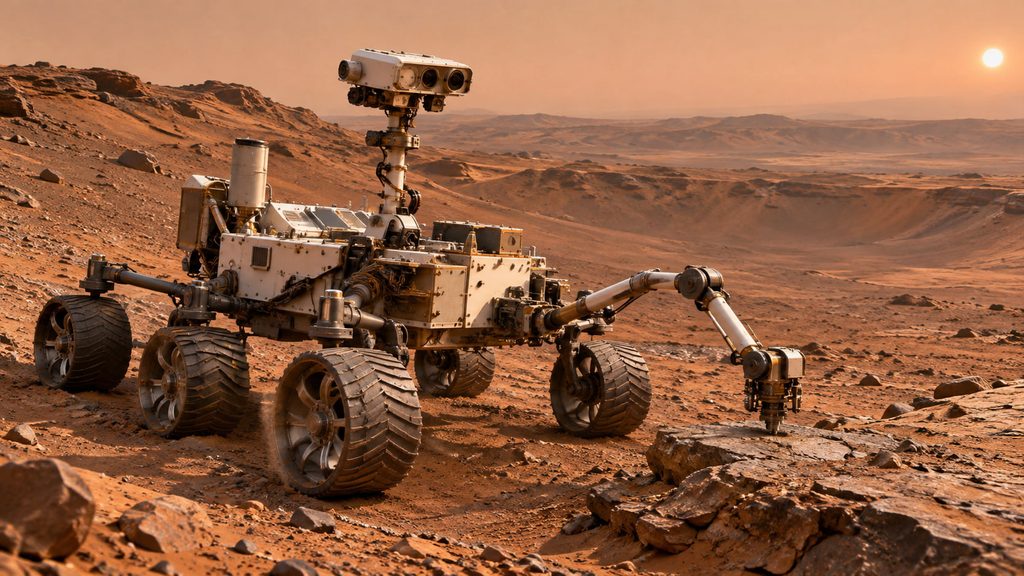
Electric vehicles are not limited to highways, city streets, and modern automotive technology. Some of the most extraordinary electric machines ever built are currently exploring the surface of Mars, while others have traveled across the Moon or are being developed for future planetary missions. These robotic explorers use electric motors, advanced batteries, intelligent navigation systems, and highly specialized suspension designs to operate in environments where conventional vehicles would be useless. Although their maximum speeds are extremely low compared with road-going electric cars, their engineering capabilities are remarkable.
By November 2026, NASA’s Curiosity and Perseverance rovers remain active on Mars, conducting scientific investigations far from Earth. Earlier machines, including Sojourner, Spirit, Opportunity, and China’s Zhurong, established important milestones in planetary exploration. Meanwhile, lunar rovers demonstrate how electric mobility can support scientific missions and eventually enable astronauts to travel farther from their landing sites. Space electric vehicles represent one of the most demanding applications of electric transportation technology, combining energy efficiency, extreme durability, and autonomous operation.
What Makes a Space Rover an Electric Vehicle?
A planetary rover is essentially a specialized electric vehicle designed to transport scientific instruments across the surface of another world. Instead of internal combustion engines, these machines use electrically driven wheels powered by rechargeable batteries and onboard electricity-generating systems. Their motors must operate under unusual conditions involving abrasive dust, extreme temperatures, reduced gravity, and terrain that has never been examined directly. Every component must also survive launch vibrations, interplanetary travel, and landing before the vehicle can begin moving.
Unlike passenger electric cars, planetary rovers are designed primarily for precision rather than speed. Their principal responsibilities include collecting images, examining rocks, measuring environmental conditions, and transporting instruments between scientifically valuable locations. Many use six independently driven wheels and sophisticated suspension systems that help maintain stability over obstacles. A rover’s success is measured by its scientific discoveries and operational reliability, not acceleration or driving performance.
Sojourner: The First Electric Rover on Mars
NASA’s Sojourner became the first successful robotic rover to operate on Mars after arriving with the Mars Pathfinder mission on July 4, 1997. Weighing approximately 11.5 kilograms, the compact six-wheeled vehicle was dramatically smaller than modern Mars explorers. It used solar cells and batteries to power its electrical systems, allowing it to move across the rocky terrain surrounding the Pathfinder lander. The mission represented a major breakthrough because it demonstrated that a remotely operated mobile robot could survive and perform useful work on another planet.
Sojourner was originally designed for a mission lasting approximately seven Martian days, but it continued operating for 83 sols. It traveled roughly 100 meters while examining rocks and collecting information about the Martian surface. Although this distance appears insignificant compared with a modern electric vehicle’s driving range, the achievement established essential engineering principles for future missions. Sojourner proved that electric mobility could transform planetary exploration from stationary observation into active surface investigation.
Spirit and Opportunity: Solar-Powered Explorers
NASA’s Spirit and Opportunity rovers landed on Mars in January 2004, introducing larger and more capable electric exploration vehicles. Each weighed approximately 185 kilograms and carried scientific instruments for examining rocks, minerals, and evidence of ancient water. Their solar panels generated electricity during daylight hours, while rechargeable batteries supplied energy when sunlight was unavailable. Both vehicles were initially designed for missions lasting only 90 Martian days.
Spirit continued exploring until communication was lost in 2010, having traveled approximately 7.7 kilometers. Opportunity achieved an even more extraordinary lifespan, operating for nearly 15 years and traveling 45.16 kilometers. Its scientific investigations provided substantial evidence that liquid water had influenced the planet’s geological history. However, a massive Martian dust storm in 2018 blocked the sunlight required for charging, eventually ending the mission despite repeated attempts to restore communication.
These two electric rovers demonstrated the advantages and limitations of solar energy in extraterrestrial environments. Solar panels eliminated the need for a large onboard fuel supply, but electricity production depended on weather, seasonal conditions, and dust accumulation. Opportunity’s remarkable longevity also showed that carefully engineered electric motors and mechanical systems could operate for years beyond their intended service life. Their achievements helped shape the design of later planetary vehicles.
Curiosity: A Nuclear-Powered Electric SUV on Mars
NASA’s Curiosity rover landed inside Gale Crater on August 6, 2012, representing a substantial increase in size and scientific capability. With a mass of approximately 899 kilograms, Curiosity is comparable in weight to a particularly small passenger car. Its six-wheel electric drivetrain allows it to navigate uneven terrain while carrying cameras, a robotic arm, drilling equipment, and scientific laboratories. The rover investigates whether ancient Martian environments could have supported microbial life.
Unlike Spirit and Opportunity, Curiosity does not depend on solar panels for its primary electricity supply. It uses a Multi-Mission Radioisotope Thermoelectric Generator that converts heat from the natural radioactive decay of plutonium-238 into electrical energy. The system initially produced slightly more than 100 watts of electricity, which is used to charge onboard batteries and support scientific operations. This continuous generation provides greater independence from sunlight and reduces vulnerability to prolonged dust storms.
Curiosity remained scientifically productive throughout 2026, more than 14 years after landing. In August 2026, NASA reported that the rover had achieved a cumulative elevation gain of approximately one kilometer while climbing Mount Sharp. Its investigations continue to reveal information about sedimentary deposits, ancient water environments, and chemical compounds preserved in Martian rocks. Curiosity demonstrates how radioisotope electricity generation can extend the operational lifespan of an electric exploration vehicle far beyond its original mission.
Perseverance: The Most Advanced Electric Rover on Mars
NASA’s Perseverance rover landed in Jezero Crater on February 18, 2021, with the primary objective of investigating ancient environments and searching for potential evidence of past microbial life. Weighing approximately 1,025 kilograms, it is larger than Curiosity and incorporates improved cameras, scientific instruments, onboard computing, and redesigned wheels. Its electrically powered drivetrain includes six wheels, allowing the rover to navigate difficult terrain while maintaining stable contact with the ground. Perseverance can also collect and seal rock samples for potential future analysis on Earth.
The rover uses a radioisotope generator that produced approximately 110 watts of electricity at the beginning of the mission. Although this sounds modest compared with automotive power systems, the generated electricity is accumulated in rechargeable batteries for higher-demand activities. Its maximum speed on suitable flat terrain is approximately 152 meters per hour, or just 0.15 kilometers per hour. Most activities are completed much more slowly because engineers prioritize traction, obstacle avoidance, and protecting expensive scientific equipment.
On October 11, 2026, Perseverance reached a total driving distance of 45.22 kilometers, surpassing Opportunity’s previous off-world driving record of 45.16 kilometers. NASA subsequently confirmed an extended mission intended to continue exploration of the Jezero Crater rim through approximately the end of 2028. This achievement is particularly significant because Perseverance accomplished the distance in considerably less time than Opportunity. Its combination of advanced electric mobility and autonomous navigation establishes a new benchmark for planetary surface exploration.
Zhurong: China’s Electric Mars Rover
China joined the group of nations operating successful Mars rovers when Zhurong reached the Martian surface in May 2021 as part of the Tianwen-1 mission. The approximately 240-kilogram vehicle explored Utopia Planitia, a vast region of the planet’s northern hemisphere. It used solar panels, electric propulsion, cameras, radar, and scientific instruments to investigate the surrounding geological environment. Its mission also demonstrated China’s ability to combine orbital exploration, landing, and surface mobility within one interplanetary program.
Zhurong exceeded its original 90-sol operational target and traveled approximately 1.92 kilometers before entering dormancy in May 2022. The shutdown was associated with the approaching Martian winter and unfavorable environmental conditions, including dust and reduced sunlight. The rover did not subsequently return to normal operation, illustrating the challenges of maintaining solar-powered machinery on Mars. Nevertheless, its successful deployment established China as another major participant in robotic planetary exploration.
How Mars Rovers Generate and Store Electricity
The fundamental difference between a conventional electric car and a Mars rover is how electricity becomes available. Passenger EVs usually depend on charging infrastructure, but robotic explorers must generate energy independently after landing. Solar-powered rovers capture sunlight through photovoltaic panels, while radioisotope-powered vehicles convert radioactive decay heat into electricity. Rechargeable batteries provide an energy buffer that supports operations requiring more power than the generator can produce instantaneously.
Each approach involves important trade-offs. Solar systems avoid carrying radioisotope fuel but are vulnerable to dust accumulation, reduced winter illumination, and severe storms. Radioisotope generators operate continuously and produce useful heat, but they require specialized materials, extensive safety procedures, and substantial engineering resources. Their electrical output also declines gradually over time.
For comparison, a modern road-going EV may have a traction motor capable of producing more than 100 kilowatts, while Perseverance’s generator initially supplied only about 110 watts of continuous electrical power. These figures describe different aspects of the systems and do not mean the rover’s wheel motors are limited to 110 watts of instantaneous output. The essential engineering objective is to conserve energy, accumulate it when possible, and use it selectively for movement, communication, heating, and scientific measurements.
Why Space Vehicles Need Special Wheels and Suspension
Driving across Mars requires a suspension system capable of handling loose sand, sharp rocks, and uneven ground without conventional roads or maintenance facilities. NASA’s larger Mars rovers use a rocker-bogie suspension architecture that allows their wheels to move relative to the chassis. This arrangement helps distribute loads and maintain contact with the ground when crossing obstacles. It also reduces the need for complicated active suspension components that could fail during extended operations.
Wheel design is particularly important because there are no repair shops on Mars. Curiosity experienced damage to its aluminum wheels during extended travel across difficult rocky terrain, providing useful engineering lessons. Perseverance incorporates redesigned aluminum wheels with more numerous, gently curved traction features and a diameter of approximately 52.6 centimeters. The resulting configuration is intended to improve durability and mobility under demanding surface conditions.
Autonomous Driving and Artificial Intelligence on Mars
Remote driving on Mars is fundamentally different from controlling a vehicle on Earth because radio communication takes considerable time to travel between the planets. Depending on their relative orbital positions, one-way communication delays can extend from several minutes to more than twenty minutes. Consequently, human operators cannot respond immediately to obstacles or unexpected wheel movements. Mars rovers must therefore combine commands from Earth with onboard navigation and hazard-detection capabilities.
Perseverance incorporates an autonomous navigation system known as AutoNav, which helps the vehicle assess terrain and select safe paths. In January 2026, NASA announced successful drives using routes planned with assistance from generative artificial intelligence. The demonstrations involved analyzing orbital imagery and terrain elevation information to identify suitable routes for the rover. This marked an important development in the application of AI to planetary mobility.
NASA Jet Propulsion Laboratory roboticist Vandi Verma, a member of the Perseverance engineering team, identified perception, localization, and planning as essential components of autonomous off-world navigation. She explained that generative AI was showing considerable promise in making these functions more efficient. Her assessment reflects a broader engineering direction in which robotic explorers are increasingly able to interpret their surroundings and support complex navigation decisions. Future Mars rovers may depend less on detailed human driving instructions while continuing to operate under carefully defined safety constraints.
Ingenuity: The Electric Aircraft That Explored Mars
Not every robotic exploration vehicle needs wheels. NASA’s Ingenuity helicopter arrived on Mars with Perseverance and completed the first powered, controlled flight on another planet in April 2021. The compact aircraft used solar energy, rechargeable batteries, and electrically driven rotors to fly through the extremely thin Martian atmosphere. Its original assignment was to demonstrate a maximum of five experimental flights.
Ingenuity ultimately completed 72 flights before its mission ended in January 2024 following damage sustained during its final landing. The helicopter demonstrated that aerial robotic vehicles could provide an additional method of exploring planetary terrain. Its achievements also established valuable experience in autonomous navigation, compact electric propulsion, and flight under extreme atmospheric conditions. Although Ingenuity was not a conventional electric car, its technology illustrates how electric mobility can extend beyond surface vehicles.
Lunokhod: The First Electric Rovers on Another World
Long before robotic vehicles explored Mars, the Soviet Union successfully operated electric rovers on the Moon. Lunokhod 1 landed in November 1970 and became the first successful remotely operated rover on another celestial body. The vehicle used eight electrically driven wheels and solar-powered energy systems, while its enclosed equipment compartment helped protect sensitive components. It traveled approximately 10.5 kilometers over more than ten months of lunar operations.
Lunokhod 2 followed in January 1973 and covered approximately 39 kilometers, a remarkable distance for its era. Both missions demonstrated the feasibility of transporting scientific equipment across extraterrestrial terrain using electric propulsion. However, the Moon presented very different engineering challenges from Mars, including a near-vacuum, abrasive regolith, and long periods without sunlight. These Soviet machines established fundamental principles that continue to influence the design of modern robotic lunar vehicles.
Apollo Lunar Rovers: Electric Cars Driven by Astronauts
NASA’s Apollo program introduced another important type of space electric vehicle: the Lunar Roving Vehicle. The first was deployed during Apollo 15 in 1971, followed by additional vehicles on Apollo 16 and Apollo 17. Unlike autonomous Mars rovers, these machines were driven directly by astronauts wearing spacesuits. Their purpose was to extend exploration beyond the immediate surroundings of the landing module.
The four-wheeled vehicles used electric motors powered by non-rechargeable batteries and incorporated lightweight frames designed for lunar conditions. Their structures could be folded for transport aboard the lunar module, making efficient use of limited spacecraft space. Apollo 17 astronauts traveled approximately 35.7 kilometers during their lunar excursions, demonstrating the scientific value of electric mobility for human exploration. These vehicles remain an important historical example of battery-powered transportation operating beyond Earth.
Modern Lunar Rovers from China and India
China renewed robotic lunar surface exploration with the Yutu rover delivered by Chang’e 3 in 2013. Its successor, Yutu-2, landed with Chang’e 4 in January 2019 and became the first rover to explore the Moon’s far side. Because direct radio communication from this region to Earth is not available, the mission depended on relay infrastructure. The rover investigated lunar soil, rocks, and subsurface characteristics while operating through the demanding lunar day-night cycle.
India achieved a major milestone with the Chandrayaan-3 mission in August 2023. Its small Pragyan rover weighed approximately 26 kilograms and traveled more than 100 meters across the lunar surface. Equipped with scientific instruments for elemental analysis, it investigated the composition of material near the lunar south polar region. These missions demonstrate that relatively compact electric rovers can make meaningful scientific contributions without the scale and complexity of a full-size Mars laboratory.
Future Space Electric Vehicles
The next generation of planetary EVs will include more specialized rovers designed to investigate locations that remain difficult to reach. The European Space Agency’s Rosalind Franklin rover is targeting a launch opportunity in 2028, followed by a journey to Mars. Its planned drilling capability will allow scientists to investigate material as deep as two meters beneath the surface. This may provide access to samples better protected from surface radiation and other environmental effects.
NASA is also developing new lunar mobility systems for scientific research and eventual human exploration. Its VIPER rover is planned for delivery to the lunar south polar region in 2027 to investigate water ice and other potentially useful materials. Additional Lunar Terrain Vehicles are being developed to support astronaut transportation and robotic operations, with deliveries targeted for 2028. These projects could help establish practical transportation systems for longer-term lunar activities.
Future extraterrestrial mobility will not depend exclusively on wheels. NASA’s Dragonfly mission is developing a nuclear-powered rotorcraft intended to explore Saturn’s moon Titan after a launch planned no earlier than 2028. The aircraft is expected to investigate different surface locations while studying the chemistry and environmental conditions of this distant world. Together, these projects show how electric propulsion and autonomous robotics are expanding the possibilities of planetary exploration.
What Space Rovers Can Teach Earth-Based Electric Vehicles
Although space rovers and passenger electric cars operate under completely different conditions, they share several important engineering principles. Both depend on reliable electric motors, energy management systems, durable electrical components, and software capable of interpreting operating conditions. Planetary exploration additionally emphasizes fault tolerance because mechanical repairs may be impossible. These requirements encourage engineers to prioritize predictable behavior and long-term reliability over maximum performance.
Space rover technology also illustrates the potential of intelligent navigation systems. Autonomous terrain assessment, precise localization, and energy-aware route planning are relevant to industrial robots, agricultural machinery, and specialized off-road electric vehicles. However, developments intended for Mars cannot always be transferred directly to commercial EVs because the operating environments and economic requirements are different. The greatest lesson from planetary exploration is that effective electric mobility depends on integrating mechanical design, power management, sensors, and software into one dependable system.
Conclusion
Space electric vehicles have transformed humanity’s ability to investigate other worlds. From the pioneering Sojourner and Lunokhod missions to Curiosity, Perseverance, and modern lunar rovers, electrically powered machines have demonstrated extraordinary durability and scientific usefulness. Their achievements show that even modest amounts of electrical power can support complex exploration when carefully managed. At the same time, environmental hazards, communication delays, and mechanical wear remain important limitations.
The October 2026 driving record achieved by Perseverance demonstrates how far planetary mobility has advanced. Future rovers will combine improved autonomous navigation, more specialized instruments, and power systems adapted to increasingly demanding destinations. These developments will support the search for ancient life, exploration of lunar resources, and preparation for future human missions. The most impressive space EVs are not defined by their speed, but by their ability to travel, survive, and make discoveries where no human driver can go.
Which space electric vehicle impresses you most: Perseverance, Curiosity, the Apollo lunar rover, or the next generation of robotic explorers? Share your thoughts in the comments.