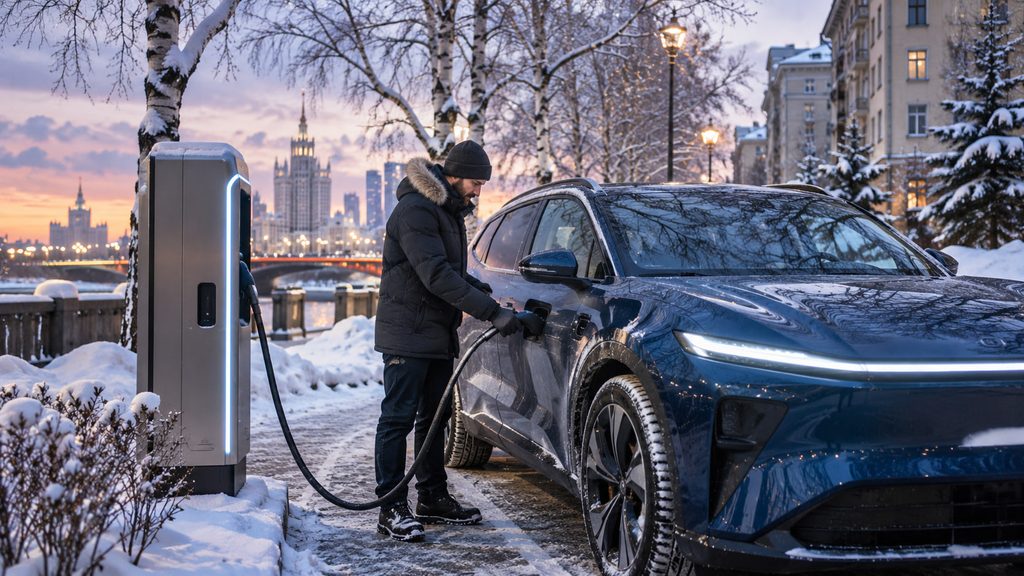
Electric cars in Russia face a combination of challenges that makes the country one of the most demanding markets for battery-powered transportation. Enormous geographical distances, exceptionally cold winters, uneven charging infrastructure, and relatively affordable conventional fuels influence how drivers evaluate electric vehicles. Nevertheless, interest in EV technology has continued to develop, supported by new models, expanding charging networks, local assembly projects, and experienced owner communities. What began largely as a niche market for imported vehicles is gradually becoming a more diverse part of the Russian automotive industry.
Recent sales figures demonstrate both the opportunities and the uncertainty surrounding this transition. After declining in 2025, registrations of new battery-electric cars recovered substantially during 2026, particularly in the second half of the year. However, electric vehicles still represent a very small share of Russia’s total passenger car fleet, and their practicality varies considerably between major cities and remote regions. The future of electric cars in Russia depends on making them affordable, reliable, and convenient under real local conditions rather than simply expanding the number of models available.
How the Russian Electric Vehicle Market Changed in 2026
Russia’s electric vehicle market has experienced significant fluctuations over the past three years. According to automotive research agency AUTOSTAT, approximately 17,800 new battery-electric passenger cars were sold in 2024, setting a national annual record. Sales declined to around 12,500 vehicles in 2025, a decrease of approximately 30%, while the electric share of the new passenger car market fell to about 0.9%. These figures reflected a market affected by vehicle prices, financing conditions, changing imports, and limited infrastructure.
The situation improved during 2026 as demand recovered and additional models entered the market. AUTOSTAT reported 3,184 new electric car sales in September, followed by a record 4,030 in October. Electric vehicles represented approximately 3% of new passenger car sales in October, while registrations during the first ten months reached about 15,580. The recovery demonstrates renewed interest, although one strong period does not guarantee uninterrupted long-term growth.
How Many Electric Cars Are Already on Russian Roads?
The existing vehicle fleet provides a more realistic picture of Russia’s progress toward electrification than monthly sales records alone. AUTOSTAT reported approximately 85,100 registered battery-electric passenger cars as of July 1, 2026. This represented only a small fraction of the country’s passenger vehicles, most of which continued to use gasoline or diesel engines. The fleet also included a substantial number of plug-in hybrids, which should be counted separately because they retain internal combustion engines.
Vehicle age and ownership patterns help explain why the transition remains gradual. A conventional car can remain in use for many years after its original purchase, and most drivers replace vehicles only when financial or practical circumstances justify the expense. Even strong growth in electric car registrations therefore changes the total fleet slowly. Russia remains at an early stage of passenger car electrification despite the improving market for new EVs.
Why Geography Creates a Unique Infrastructure Challenge
Russia’s geographical scale has an enormous influence on transportation requirements. Major metropolitan areas offer relatively concentrated populations, commercial services, and developing charging networks. By contrast, remote communities may be separated by hundreds of kilometers, with limited roadside facilities and challenging weather conditions. A vehicle that is convenient for commuting in Moscow may be considerably less practical for long-distance travel through sparsely populated regions.
The economics of charging infrastructure also change with population density. Installing an expensive fast charger is easier to justify when numerous drivers use it every day, while equipment in remote locations may remain underutilized. Maintenance services and dependable electrical connections can also be more difficult to arrange outside major transport corridors. Russia’s EV transition will therefore depend on regional circumstances rather than following one uniform national pattern.
Where Is Charging Infrastructure Developing?
Russia’s public charging network has expanded significantly in recent years. AUTOSTAT estimated that the country had almost 8,000 public charging stations in April 2026. However, the distribution remained uneven, with a substantial concentration in Moscow, Saint Petersburg, and several other economically active regions. Drivers outside these areas often need to plan journeys more carefully because charging locations may be farther apart.
Highway infrastructure is gradually improving as well. In July 2026, Russia’s Ministry of Transport announced two major charging complexes on the M-11 highway, with 13 charging stations at one site and 14 at another. These facilities support travel between Moscow and Saint Petersburg, one of the country’s most important intercity routes. The challenge is to develop similarly dependable charging opportunities across a much wider network of roads and regions.
Why the Number of Chargers Is Not Enough
A large number of advertised charging stations does not automatically guarantee a convenient experience for electric vehicle owners. Drivers must consider whether equipment is operational, accessible, appropriately powered, and compatible with their vehicles. Charging operators also need dependable payment systems, technical support, and arrangements for maintenance when equipment fails. In remote areas, one unavailable charger can create a substantially greater inconvenience than several occupied chargers in a city.
Charging performance varies considerably between stations and vehicles. A charger rated at 150 kW does not necessarily deliver that power throughout an entire session because the battery’s temperature and state of charge influence the charging rate. For example, replenishing 40 kWh at an average effective power of 80 kW would theoretically require about 30 minutes, excluding additional overhead. Actual charging time depends on average power delivery rather than the highest number displayed on the equipment.
Different Charging Standards Complicate Ownership
Russia’s diverse import market creates additional technical challenges because electric vehicles have arrived from several automotive regions. Older Japanese vehicles such as the Nissan Leaf commonly use CHAdeMO for DC fast charging, while European-market cars frequently support CCS Combo 2. Chinese-market vehicles may rely on GB/T connectors, creating different requirements for charging compatibility. These standards cannot simply be treated as interchangeable versions of the same electrical connection.
Some adapters and conversion solutions are available, but compatibility depends on the vehicle, equipment, and communication protocols. An apparently suitable charger may still be unusable if the connector or software handshake is incompatible. Buyers should therefore verify the charging system before purchasing an imported vehicle, particularly if it comes from a market with different infrastructure standards. Charging compatibility can be just as important as battery capacity when evaluating an EV for everyday use in Russia.
Can Electric Cars Operate in Severe Russian Winters?
Cold weather is one of the most frequently discussed concerns about EV ownership in Russia. Modern battery-electric vehicles can operate below freezing, but low temperatures reduce efficiency and increase the energy needed for cabin heating and battery management. Snow-covered roads, winter tires, and strong winds can create additional energy consumption. These effects are especially relevant in regions where temperatures remain far below zero for extended periods.
Independent winter testing demonstrates the potential scale of range reduction. During the Norwegian Automobile Federation’s 2026 winter test, 24 electric vehicles were evaluated in conditions reaching minus 32 degrees Celsius. Their measured driving range averaged approximately 38% below official WLTP figures, although individual results varied considerably. These findings do not establish a universal winter range loss, but they show why drivers should plan substantial energy reserves in severe cold.
Why Battery Performance Changes in Cold Weather
Lithium-ion batteries depend on electrochemical processes that are sensitive to temperature. Cold conditions can increase internal resistance and temporarily limit how efficiently a battery delivers or accepts energy. The vehicle may also use electricity to warm the battery and maintain safe operating temperatures. Cabin heating adds another substantial demand, particularly during short journeys when the vehicle starts from a cold condition.
Modern EVs address these problems with battery management systems, thermal conditioning, and increasingly efficient heating technologies. Heat pumps can reduce electricity consumption compared with resistance heating under suitable operating conditions, while battery preconditioning improves charging performance. Nevertheless, effectiveness varies by model and outside temperature. Buyers in colder Russian regions should evaluate thermal management and demonstrated winter performance rather than relying exclusively on laboratory range figures.
What Winter Driving Experts Recommend
The Norwegian Automobile Federation provides useful evidence about the practical requirements of cold-weather electric driving. Following its unusually demanding 2026 winter test, test manager Kjersti Stuestol warned that drivers of several popular family EVs should be prepared for substantially reduced range during extreme cold. Her assessment emphasized that some vehicles may need recharging after covering only around half their advertised distance under particularly harsh conditions. Although the test took place in Norway, the findings are relevant to similarly severe weather encountered in parts of Russia.
Practical preparation can reduce some of the inconvenience. Drivers should preheat vehicles while connected to external power when possible, use battery preconditioning before suitable fast-charging stops, and avoid arriving at remote chargers with minimal energy remaining. Winter route planning should also allow for weather delays and unexpectedly high consumption. Reliable winter EV ownership requires conservative planning rather than assuming that every journey will match favorable test conditions.
Home Charging Can Make EV Ownership Much Easier
Access to private charging is one of the biggest advantages an electric vehicle owner can have. A properly installed residential charger allows the battery to replenish overnight without requiring frequent visits to public infrastructure. This is particularly convenient for drivers with predictable daily mileage and access to private parking. It also reduces dependence on the availability of public charging equipment during cold weather.
Apartment residents often face a more complicated situation. Installation may require building permissions, sufficient electrical capacity, dedicated parking arrangements, and investment in appropriate protection equipment. Charging from improvised extension cables or unsuitable wiring can introduce serious electrical and fire risks. Home charging can transform the ownership experience, but installations should be designed and inspected by qualified professionals.
Are Electric Cars Cheaper to Operate?
Electric motors are considerably more energy-efficient than conventional combustion engines, which can make electric driving economical when electricity prices are favorable. Consider an illustrative electric vehicle consuming 18 kWh per 100 kilometers and a gasoline car using 8 liters over the same distance. At an assumed residential electricity price of 6 rubles per kWh, the electric vehicle would consume approximately 108 rubles of energy before charging losses. At an assumed gasoline price of 65 rubles per liter, the combustion-engine vehicle would require approximately 520 rubles of fuel.
These prices are hypothetical examples rather than current national averages, since regional tariffs and retail fuel prices vary. Public fast charging can also cost substantially more than residential electricity, reducing the financial advantage. Insurance, depreciation, financing, tire wear, and maintenance must be included in a complete comparison. Electric vehicles can offer meaningful operating savings, but the benefit depends heavily on how and where the owner charges.
Which Electric Cars Are Popular in Russia?
Russia’s EV fleet contains a distinctive combination of Japanese imports, Chinese models, Western vehicles, and locally assembled products. The Nissan Leaf played a major role during the early development of the market, particularly through imported used vehicles. According to AUTOSTAT, the Leaf accounted for slightly more than 22% of registered battery-electric passenger cars in July 2026. The Zeekr 001 ranked second, representing approximately 11.7% of the fleet.
The market for newly purchased electric vehicles looks different from the existing fleet. Chinese-developed models have gained importance because they offer modern software, competitive equipment, and a variety of vehicle types. During October 2026, the Changan Qiyuan Q05 and Toyota bZ3X were among the strongest-selling electric models. The contrast between older fleet favorites and newer sales leaders demonstrates how rapidly consumer choice is evolving.
Chinese Electric Cars Are Changing Consumer Expectations
Chinese manufacturers have become influential suppliers of electric vehicles to the Russian market. Brands such as Zeekr, BYD, Avatr, and other Chinese automotive groups offer vehicles with advanced infotainment systems, competitive performance, and increasingly sophisticated battery technology. Their popularity also reflects changes in international automotive supply chains and vehicle availability. However, differences between official distribution and independent imports can significantly affect the ownership experience.
A car originally intended for the Chinese domestic market may have software, charging equipment, or connected services that require special consideration. Warranty coverage and access to replacement parts may also differ depending on the importer. Buyers should investigate whether authorized or qualified independent service facilities can maintain the specific model. Attractive specifications are only part of a good purchase when long-term technical support remains uncertain.
Russia’s Domestic Electric Vehicle Projects
Russia has pursued several initiatives intended to develop local electric vehicle assembly and automotive production. Evolute has become one of the more visible brands, offering electric crossovers and other passenger models assembled in the Lipetsk region. Moskvich has also offered the 3e electric crossover, while Amberauto represents another domestic-branded project. These vehicles illustrate efforts to establish a larger local market and strengthen selected manufacturing capabilities.
However, domestic branding should not automatically be equated with complete domestic engineering or component production. Electric motors, battery cells, power electronics, and software may be sourced from international suppliers or developed through manufacturing partnerships. Greater localization requires significant investment in equipment, engineering expertise, and reliable supply chains. The long-term success of local EV manufacturing depends on producing competitive vehicles with dependable service and sustainable costs.
How Enthusiasts Helped Develop the Market
Enthusiast communities played an important role in Russia before electric vehicles became widely available through conventional dealerships. Early owners of imported Nissan Leaf and Tesla vehicles shared information about charging locations, battery health, and winter performance. Their experiences helped other drivers understand the practical differences between electric and combustion-engine ownership. Community discussions also supported the development of technical knowledge around used EV inspection and maintenance.
These networks remain useful because vehicle configurations and charging infrastructure vary considerably. Owners can exchange practical observations about specific routes, equipment compatibility, and regional service availability. However, informal advice cannot replace qualified high-voltage repair work or verified manufacturer instructions. The contribution of enthusiasts has been demonstrating both the possibilities and limitations of EV ownership under Russian conditions.
Government Incentives and Regional Differences
Government policies have influenced Russia’s electric vehicle market through infrastructure programs, financing support, and selected ownership benefits. Eligible buyers of qualifying vehicles may receive subsidized financing under applicable support programs, although conditions can change with funding availability and vehicle eligibility. Some regions also provide transport tax exemptions or other financial advantages for electric vehicles. These benefits are not necessarily identical across the country.
Buyers should distinguish between national policies and regional incentives. A vehicle eligible for a tax advantage in one region may face different rules elsewhere. Requirements can also depend on vehicle registration, production origin, motor power, or specific program conditions. Checking current local regulations before purchase is essential when estimating the total financial advantages of electric car ownership.
Maintenance, Battery Health, and Used Electric Cars
Electric vehicles generally require less routine maintenance of conventional powertrain components because they do not use engine oil, spark plugs, or exhaust systems. Nevertheless, they still need brake inspections, tire replacement, suspension maintenance, thermal system servicing, and electrical checks. Battery health becomes especially important when evaluating older vehicles. A reduced usable battery capacity can affect range and resale value even when the car otherwise operates normally.
Prospective buyers should examine available diagnostic information, charging behavior, service history, and the condition of high-voltage components. Replacement battery packs and electronic control modules can be expensive, particularly for vehicles lacking comprehensive manufacturer support. A qualified inspection can therefore be valuable before purchasing a used or independently imported EV. Lower routine maintenance requirements do not mean that electric cars are free from expensive technical problems.
What to Expect From Electric Cars in Russia
The coming years are likely to bring gradual expansion rather than a uniform nationwide transition. Major cities and well-supported highways may experience faster EV adoption because charging services and specialized maintenance are more accessible. Greater model availability and improved battery technology could make electric vehicles attractive to additional consumers. Nevertheless, financing costs, import conditions, electricity tariffs, and service availability will continue influencing demand.
The strong sales recovery during 2026 demonstrates that the market has potential, but longer-term growth will require dependable infrastructure and consumer confidence. Charging investments must extend beyond the most commercially attractive metropolitan locations. Manufacturers and service providers will also need to address compatibility, spare parts, and battery performance under demanding conditions. The future Russian EV market will be shaped by practical ownership economics more than by ambitious technological promises alone.
Conclusion
Electric cars in Russia are progressing from an enthusiast-driven niche toward a more diverse automotive market. New models, expanding charging networks, and local assembly projects are gradually improving consumer choice. However, extreme winter conditions, large geographical distances, inconsistent charging coverage, and uncertain maintenance support remain significant barriers. The recovery in 2026 registrations shows renewed demand, but battery-electric vehicles still account for only a small part of the existing vehicle fleet.
For individual buyers, the most important considerations are access to charging, realistic winter range, driving patterns, total costs, and dependable technical support. An electric vehicle may be highly practical for urban commuting while remaining inconvenient for frequent journeys through remote areas. The suitability of the technology therefore depends on local conditions rather than general assumptions about EV performance. Russia’s electric vehicle market can continue growing, but successful adoption requires infrastructure and ownership services that match the country’s distinctive transportation needs.
Would you choose an electric car for everyday driving in Russia, or would winter conditions and charging limitations make a conventional vehicle more practical? Share your opinion in the comments.