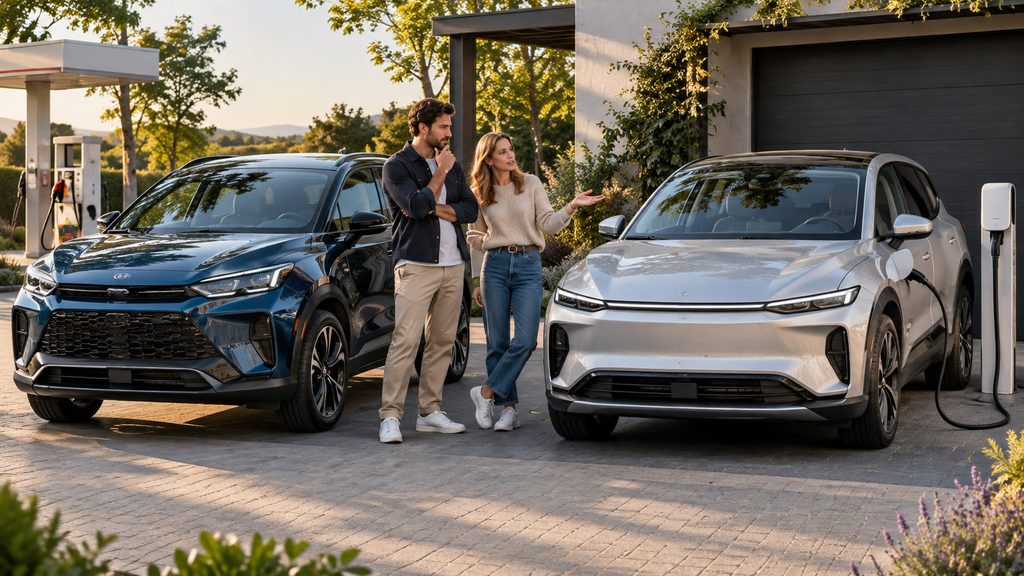
Choosing between a hybrid and an electric car has become one of the most important decisions for modern drivers. Both technologies can reduce energy consumption compared with traditional gasoline vehicles, but they deliver their advantages in different ways. Hybrids combine combustion engines with electric motors, while fully electric cars operate entirely on battery power. Their differences affect purchase prices, driving range, maintenance requirements, environmental impact, and everyday convenience.
By 2026, electric vehicles have become more practical, while conventional hybrids remain highly competitive in fuel efficiency and reliability. Plug-in hybrids provide a third option by combining substantial electric driving capability with gasoline backup. However, technological progress has not produced a universal winner for every driver. The best choice depends on charging availability, annual mileage, fuel prices, driving conditions, and long-term ownership priorities.
Understanding the Difference Between Hybrids and Electric Cars
A conventional hybrid electric vehicle, or HEV, combines a gasoline engine with an electric motor and a relatively small battery. The battery receives electricity through regenerative braking and energy generated by the combustion engine, so external charging is unnecessary. The Toyota Prius Hybrid, Toyota Corolla Hybrid, and Honda CR-V Hybrid are familiar examples of this technology. Their primary advantage is improved fuel efficiency without changing traditional refueling habits.
A plug-in hybrid electric vehicle, or PHEV, has a larger battery that can be charged externally. Many models can complete daily journeys using electricity before switching to hybrid operation when necessary. For example, the 2026 Toyota Prius Plug-in Hybrid offers up to 44 miles of EPA-estimated electric range in its SE configuration. Plug-in hybrids deliver their greatest benefits when owners charge regularly rather than relying primarily on gasoline.
A battery electric vehicle, or BEV, uses rechargeable batteries to power one or more electric motors without a combustion engine. Models such as the Hyundai Ioniq 5, Tesla Model 3, Kia EV6, and Volkswagen ID.4 demonstrate the variety of vehicles available in this category. Battery electric cars produce no tailpipe emissions and do not need gasoline, engine oil, or conventional exhaust systems. However, their practicality depends on sufficient driving range and dependable access to charging infrastructure.
Driving Range: Hybrids Have an Important Advantage
Driving range remains a major reason why some motorists prefer hybrid vehicles. Efficient gasoline-electric models can travel hundreds of miles without refueling, and gasoline stations remain widely available in many regions. The 2026 Toyota Prius achieves up to 57 mpg combined according to EPA estimates, depending on the configuration. This efficiency makes conventional hybrids particularly attractive for drivers covering long distances.
Fully electric cars have improved considerably, with some modern models offering more than 300 miles of EPA-estimated range. Nevertheless, actual results depend on vehicle specifications, temperature, driving speed, and terrain. Sustained motorway driving or freezing weather can significantly increase energy consumption. Unlike a hybrid, a fully electric car must eventually reach a compatible charging station to continue its journey.
Plug-in hybrids combine these approaches by offering a relatively short electric driving range and a conventional gasoline-powered fallback. A driver with a 25-mile commute could potentially travel entirely on electricity during the working week and use gasoline for occasional longer trips. This flexibility is useful when charging infrastructure is inconsistent. For drivers who regularly travel through remote areas, hybrids generally offer greater refueling convenience.
Charging Convenience vs Traditional Refueling
Conventional hybrids require no charging installation, making them particularly convenient for apartment residents and people without private parking. Their owners can refuel in approximately the same way as drivers of conventional gasoline vehicles. There is no need to investigate charging standards or plan charging sessions. This simplicity remains a major competitive advantage.
Electric vehicle ownership becomes substantially more convenient when home charging is available. Many owners can recharge overnight and begin each morning with sufficient range for normal daily activities. Public DC fast charging provides additional flexibility, although performance differs between vehicles and charging stations. Some electric cars can replenish approximately 10% to 80% battery charge in around 20 minutes under favorable conditions, while others require considerably longer.
Charging costs and reliability also vary between locations. Public chargers may be expensive, occupied, or temporarily unavailable, while home electricity can be considerably cheaper. Drivers relying exclusively on public charging therefore face different practical and financial conditions from homeowners with private chargers. Reliable home charging is one of the strongest arguments in favor of buying a fully electric car.
Fuel Efficiency and Energy Consumption
Battery electric vehicles use energy more efficiently than combustion-powered vehicles because electric motors convert a larger proportion of stored energy into movement. They also recover some braking energy through regenerative braking, which improves efficiency during urban driving. Conventional hybrids use the same principle to reduce gasoline consumption. However, their engines still lose substantial amounts of energy through heat and mechanical processes.
For a practical comparison, the 2026 Toyota Prius can achieve up to 57 mpg combined, while certain 2026 Hyundai Ioniq 5 configurations consume approximately 30 kWh per 100 miles. These figures cannot be compared directly without considering gasoline and electricity prices. Electricity consumption also varies with vehicle weight, aerodynamics, tires, and weather. The most efficient powertrain is not necessarily the least expensive to operate under every local energy tariff.
Running Costs: Which Is Cheaper?
Operating expenses provide an important advantage for electric cars when electricity is affordable. Consider a conventional hybrid consuming 5 liters of gasoline per 100 kilometers, with gasoline priced at €1.70 per liter. The resulting fuel cost would be €8.50 per 100 kilometers. An electric vehicle consuming 18 kWh over the same distance would cost €3.60 when charged at €0.20 per kWh, excluding charging losses.
The financial picture changes when electricity becomes expensive. At a public charging tariff of €0.60 per kWh, the example electric vehicle would cost €10.80 per 100 kilometers, exceeding the hybrid’s gasoline expense. Over 15,000 kilometers annually, the hybrid would spend approximately €1,275 on gasoline, compared with €540 for the EV using the assumed home electricity rate. This produces an illustrative annual energy saving of €735 before accounting for charging losses and other expenses.
These calculations are examples rather than universal ownership estimates. Actual costs depend on driving conditions, electricity contracts, regional taxes, and vehicle efficiency. Drivers should also consider whether installing a private charger involves substantial additional expense. Electric cars generally provide their strongest financial advantage when owners can charge regularly at relatively low electricity prices.
Purchase Price and Long-Term Value
Purchase prices vary considerably by brand, vehicle segment, and regional market. Conventional hybrids are available in relatively affordable compact models, whereas some fully electric vehicles remain more expensive than similarly sized gasoline-electric alternatives. However, increased production and lower battery costs are gradually improving EV affordability. The International Energy Agency reported that 70% of battery electric cars sold in China during 2025 were cheaper than the average conventional car sold there.
Plug-in hybrids may command higher prices because they contain both a conventional engine and a larger electrical propulsion system. This additional equipment can make them expensive relative to ordinary hybrids. Their financial advantages depend on using electricity frequently enough to offset the initial premium. Buyers who rarely charge may find that a conventional hybrid offers better overall value.
Depreciation, insurance, maintenance, taxes, and resale value must also be considered. Electric car depreciation can be affected by changing battery technology, manufacturer pricing, and regional demand. Government incentives may improve affordability, but their availability differs between countries and can change. A realistic comparison should consider five to eight years of total ownership costs rather than purchase price alone.
Maintenance and Reliability
Fully electric vehicles generally require less routine powertrain maintenance than hybrids. They do not need engine oil changes, spark plugs, fuel filters, or exhaust system repairs. The U.S. Department of Energy confirms that all-electric vehicles typically have fewer moving parts and fluids requiring regular servicing. Regenerative braking can also reduce mechanical brake wear, although brake components still require periodic inspection.
Conventional hybrids retain gasoline engines, but mature hybrid systems have established a strong reliability record. Consumer Reports’ automotive reliability findings published in December 2025 highlighted generally favorable results for conventional hybrids. The organization’s survey included responses covering approximately 380,000 vehicles, while EVs and plug-in hybrids continued to show more problems on average. However, reliability varies substantially between individual models and manufacturers.
Jake Fisher, senior director of auto testing at Consumer Reports, has explained that many problems affecting electric vehicles and plug-in hybrids arise because their newer designs still require refinement. This is an important reminder that mechanical simplicity does not guarantee freedom from software, charging, or electrical faults. Some individual electric vehicles perform very well, while others experience persistent technical problems. Buyers should investigate model-specific reliability rather than judging an entire powertrain category.
Battery Life and Replacement Costs
All three powertrain categories use rechargeable batteries, but battery capacity and operating requirements differ considerably. Conventional hybrids typically use smaller traction batteries because their combustion engines provide most of the vehicle’s sustained energy supply. Plug-in hybrids have larger batteries intended to support meaningful electric driving, while BEVs depend on substantially larger battery packs. Each technology uses electronic management systems to protect the battery and control charging.
Battery degradation occurs gradually and depends on temperature, chemistry, operating conditions, and charging behavior. Many battery electric cars offer traction battery warranties of approximately eight years or 100,000 miles in the United States, although actual coverage varies. Battery replacement can be expensive, but complete replacement is not an inevitable event at a particular mileage. Buyers considering used electrified vehicles should prioritize battery health reports, warranty coverage, and documented maintenance history.
Driving Comfort and Performance
Fully electric cars frequently deliver stronger initial acceleration because electric motors produce torque immediately. Their operation is generally smooth and quiet, especially at low speeds. Many offer regenerative braking modes that allow substantial speed reduction without frequent use of the conventional brake pedal. These characteristics can make everyday urban driving particularly comfortable.
Hybrids offer quieter operation than many traditional gasoline vehicles, especially when traveling slowly under electric power. However, the combustion engine still operates during acceleration, heating demand, or sustained driving. Plug-in hybrids can provide a more electric-like experience while battery energy remains available. Their transitions between electric and gasoline operation may nevertheless be noticeable depending on the model.
Electric cars also often carry substantial battery weight, which influences handling, suspension design, and tire wear. Their actual driving characteristics depend on much more than their powertrain. A well-engineered hybrid can offer better ride comfort than a poorly designed electric vehicle. Test-driving the specific models under consideration remains essential.
Winter Performance and Cold Weather Limitations
Cold weather affects the efficiency of both hybrid and fully electric vehicles. Electric cars can lose usable driving range because battery performance changes at low temperatures and cabin heating requires additional energy. DC fast charging may also slow when the battery is cold. Battery preconditioning and efficient heat pumps can reduce some of these limitations.
Hybrids are less dependent on electric driving range, but their fuel consumption can increase during winter. Their gasoline engines may run more frequently to provide cabin heat and maintain operating temperatures. Plug-in hybrids may also activate their engines during cold weather even when battery energy remains available. The exact behavior depends on the vehicle’s heating system and control software.
For drivers living in colder regions, winter range should be an important purchasing consideration. An EV with adequate range and home charging can remain highly convenient throughout the year. Drivers making frequent long journeys through poorly served regions may prefer a hybrid. Real-world winter capability matters more than the maximum range advertised under ideal testing conditions.
Environmental Impact: Which Is Greener?
Battery electric vehicles produce no exhaust emissions while driving, reducing local air pollution. However, their total environmental impact includes battery manufacturing, electricity generation, vehicle production, and end-of-life processing. Conventional hybrids generally require smaller batteries but continue consuming gasoline throughout their service lives. Plug-in hybrids can reduce combustion emissions when used primarily in electric mode.
The International Energy Agency’s 2026 lifecycle analysis indicates that battery electric vehicles generally produce substantially lower greenhouse gas emissions than comparable hybrids. Assuming approximately 60% electric driving, the agency estimated that plug-in hybrids generate around 30% fewer lifecycle emissions than conventional hybrids but approximately 40% more than battery electric cars. These estimates depend on electricity generation, manufacturing methods, vehicle size, and driving behavior. They should not be interpreted as identical results for every country or individual driver.
Battery manufacturing also involves mining, material processing, and energy-intensive industrial activities. Responsible sourcing, battery recycling, and cleaner electricity production remain important for reducing these impacts. Nevertheless, lifecycle research generally favors battery electric vehicles over comparable gasoline-powered alternatives. For drivers prioritizing lower lifetime greenhouse gas emissions, a suitably sized battery electric car is usually the stronger option.
Are Plug-In Hybrids the Best Compromise?
Plug-in hybrids combine many advantages of conventional hybrids and battery electric vehicles. Their electric range can cover shorter daily journeys, while gasoline operation remains available for longer trips. The 2026 Toyota Prius Plug-in Hybrid illustrates this concept with up to 44 miles of EPA-estimated electric range and up to 52 mpg combined in gasoline-hybrid operation. Regular charging is essential to achieving its full efficiency potential.
However, plug-in hybrids also combine mechanical and electrical complexity. They require engine servicing and charging equipment, while carrying the weight of both propulsion systems. When the battery’s usable electric range is exhausted, the vehicle relies on gasoline for much of its continued operation. Owners who seldom charge may receive limited benefits relative to a simpler hybrid.
A plug-in hybrid makes the most sense for drivers who can charge frequently but regularly need gasoline-powered flexibility. For people already equipped with dependable home charging and rarely traveling beyond an EV’s range, a fully electric vehicle may be simpler. For those without charging access, a conventional hybrid often provides better value. The compromise is useful only when it matches actual driving habits.
Which Technology Is Better for City and Highway Driving?
Urban driving generally favors electric propulsion because frequent stops allow regenerative braking to recover energy. Fully electric cars offer quiet operation, responsive acceleration, and zero local exhaust emissions. Their everyday convenience becomes particularly strong when drivers can charge at home or at work. Conventional hybrids remain a practical alternative for city residents without private charging facilities.
Long-distance travel gives hybrids a different advantage because refueling is quick and widely available. Modern electric cars can handle extensive motorway journeys, especially along routes with dependable high-power charging networks. However, additional stops and charging time may still be necessary. Drivers frequently covering hundreds of kilometers should compare actual route charging availability before committing to a fully electric car.
Which Is the Best Choice for Different Drivers?
For urban commuters with dependable home charging, a battery electric vehicle often offers the best combination of low energy costs, comfort, and reduced maintenance. Drivers without charging facilities may find a conventional hybrid more convenient, particularly when refueling flexibility matters. People who regularly cover long distances through regions with limited charging infrastructure also have strong reasons to choose a hybrid. Plug-in hybrids are most appealing to drivers who can complete most daily journeys electrically while occasionally requiring gasoline backup.
Budget-conscious buyers should compare vehicles within the same size and equipment category rather than comparing an inexpensive hybrid with a premium electric SUV. Families should also examine cargo space, passenger comfort, safety ratings, insurance costs, and warranty conditions. Charging convenience is important, but it should not overshadow the vehicle’s overall suitability. The correct choice is the one that offers the best combination of everyday practicality, affordability, reliability, and long-term value.
Conclusion
Hybrid and fully electric cars both provide meaningful advantages, but neither technology is universally superior. Conventional hybrids offer strong fuel economy, convenient refueling, and proven reliability, making them particularly attractive to motorists without dependable charging access. Fully electric vehicles deliver greater powertrain efficiency, quieter operation, fewer routine maintenance requirements, and generally lower lifetime greenhouse gas emissions. Plug-in hybrids occupy a useful middle ground, although their benefits depend heavily on regular charging.
For most drivers with affordable home charging and predictable daily mileage, a fully electric car is generally the better long-term choice. Conventional hybrids remain an excellent alternative for people who travel extensively, cannot install chargers, or prefer simpler ownership arrangements. Plug-in hybrids are best suited to motorists who can use electric power frequently while still benefiting from gasoline backup. Ultimately, choosing between a hybrid and an electric car should be based on real driving needs rather than assumptions about which technology is more advanced.
Would you choose a conventional hybrid, a plug-in hybrid, or a fully electric car in 2026? Share your experience and opinion in the comments.