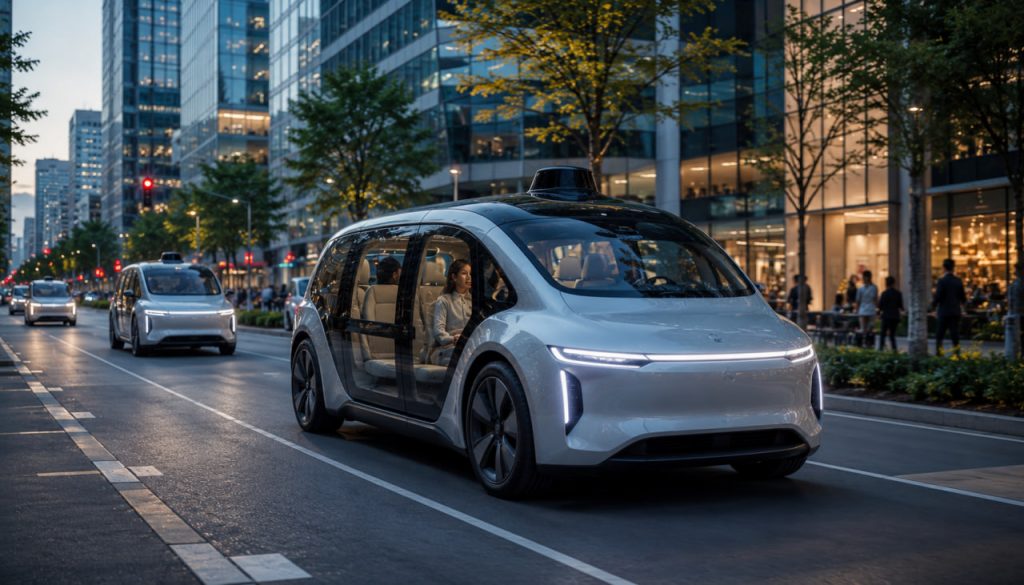
Driverless electric vehicles combine two of the automotive industry’s most disruptive technologies: battery-electric propulsion and automated driving. Instead of relying on a human driver and an internal-combustion engine, these vehicles use electric motors, rechargeable batteries, sensors, high-performance computers, and artificial intelligence to travel with limited or no human control.
The concept is often associated with robotaxis, autonomous delivery vans, and purpose-built urban shuttles. However, the term “driverless” is frequently used too loosely. Many vehicles marketed with advanced driving features still require constant human supervision and are not truly autonomous.
A genuinely driverless vehicle must be capable of performing the complete driving task within defined conditions without expecting a human occupant to monitor the road or take immediate control.
What Is a Driverless Electric Vehicle?
A driverless electric vehicle is a battery-powered road vehicle equipped with an automated driving system that can control steering, acceleration, braking, lane positioning, and responses to surrounding traffic.
Depending on its level of automation, the vehicle may be able to:
- Detect roads, vehicles, pedestrians, and cyclists
- Interpret traffic lights and road signs
- Select an appropriate route
- Maintain a safe following distance
- Change lanes
- Navigate intersections
- Respond to unexpected hazards
- Stop safely when operating conditions become unsuitable
Electric propulsion is not required for automated driving, but most purpose-built driverless vehicles are electric because electric drivetrains are relatively easy to control electronically and fit naturally into software-centered vehicle architectures.
Understanding the Levels of Driving Automation
The SAE International J3016 standard defines six levels of driving automation, ranging from Level 0 to Level 5. The classification is based on which party performs the driving task and who must respond when the system reaches its limits.
Level 0: No Driving Automation
The human performs the entire driving task. The vehicle may provide warnings or brief emergency intervention, but it does not drive continuously.
Level 1: Driver Assistance
The system can assist with either steering or speed control. The driver remains responsible for monitoring the road and controlling the vehicle.
Level 2: Partial Driving Automation
The vehicle can control steering and speed simultaneously under certain conditions. The driver must remain attentive and ready to intervene at all times.
Level 2 systems are advanced driver-assistance technologies, not driverless systems.
Level 3: Conditional Driving Automation
The automated system performs the complete driving task within a defined operating environment. However, the human must be available to take control when requested.
Level 4: High Driving Automation
The system performs the complete driving task without requiring human supervision, but only within a limited operational design domain. This domain may be restricted by geography, weather, road type, speed, or time of day.
NHTSA describes Level 4 vehicles as systems that are fully responsible for driving within limited service areas while occupants act only as passengers.
Level 5: Full Driving Automation
The vehicle can theoretically drive under all road and environmental conditions in which a competent human driver could operate.
At Level 5, steering wheels and pedals may no longer be necessary. NHTSA states that occupants in a Level 5 vehicle would act only as passengers and would not need to remain engaged in the driving task.
Most Consumer Vehicles Are Not Truly Driverless
Many modern electric cars include adaptive cruise control, automated lane centering, assisted lane changes, parking assistance, and automated motorway driving.
These features can reduce workload, but they generally remain Level 2 systems. The person behind the wheel is still legally and operationally responsible for observing traffic and responding to hazards.
NHTSA distinguishes advanced driver-assistance systems from automated driving systems. According to the agency, automated driving systems generally include Levels 3 through 5, while Level 2 systems still require continuous driver involvement.
A vehicle should not be considered driverless simply because it can steer, brake, or follow a route during part of a journey.
How Driverless EV Technology Works
An autonomous electric vehicle continuously observes its surroundings, estimates its position, predicts what nearby road users may do, and selects a safe driving action.
This process depends on several connected technological layers.
Cameras
Cameras capture visual information about:
- Lane markings
- Traffic signals
- Road signs
- Vehicles
- Pedestrians
- Cyclists
- Construction zones
- Road boundaries
Modern computer-vision systems analyze these images to classify objects and understand the driving environment.
Cameras provide rich detail but can be affected by darkness, glare, fog, heavy rain, dirt, and snow.
Radar
Radar uses radio waves to estimate the distance and relative speed of surrounding objects.
It is especially useful for:
- Tracking vehicles
- Measuring closing speed
- Operating in poor visibility
- Supporting emergency braking
- Maintaining safe following distances
Radar generally provides less visual detail than cameras but can remain effective under conditions that reduce camera performance.
Lidar
Lidar sends laser pulses into the environment and measures how quickly they return. This allows the system to create a detailed three-dimensional representation of roads, vehicles, buildings, and other objects.
Lidar can provide accurate depth information, although its cost, placement, cleaning requirements, and performance in difficult weather remain important engineering considerations.
Ultrasonic Sensors
Short-range ultrasonic sensors are commonly used for:
- Parking
- Detecting nearby obstacles
- Low-speed maneuvering
- Measuring space around the vehicle
They are particularly valuable when the vehicle is operating close to walls, curbs, or other vehicles.
Satellite Navigation and Digital Maps
Satellite positioning helps determine the vehicle’s general location. High-definition maps may add detailed information about:
- Lane geometry
- Road curvature
- Traffic controls
- Speed limits
- Junction layouts
- Road boundaries
Because satellite signals can be blocked or reflected in tunnels and dense cities, autonomous systems usually combine navigation data with cameras, inertial sensors, wheel measurements, and map matching.
Sensor Fusion
No single sensor is reliable under every condition.
Sensor fusion combines information from cameras, radar, lidar, ultrasonic sensors, maps, and vehicle-motion sensors. The system compares these inputs to develop a more reliable model of the surrounding environment.
Sensor redundancy is essential because an automated vehicle must remain safe even when an individual sensor is obstructed, damaged, or uncertain.
Artificial Intelligence and Decision-Making
Artificial intelligence helps the vehicle recognize patterns and interpret complex situations.
The software must determine:
- Which objects are moving
- Which lane is safe
- Whether a pedestrian may enter the road
- Whether another vehicle is likely to merge
- When to stop
- How quickly to accelerate
- Whether a route is blocked
- When a minimum-risk stop is necessary
The system does not merely react to current positions. It must predict how the scene may develop over the next several seconds.
NHTSA has emphasized that automated driving requires extensive training data, high-quality sensor input, and substantial computing power capable of processing information almost instantly.
Why Electric Powertrains Suit Driverless Vehicles
Electric vehicles are particularly suitable for autonomous fleets.
Electric motors offer:
- Precise electronic torque control
- Rapid response
- Smooth acceleration
- Regenerative braking
- Fewer mechanical drivetrain components
- Easy integration with centralized vehicle software
An autonomous system can command an electric motor directly and receive an immediate, predictable response.
Battery-electric platforms also provide flexible packaging. Without a large combustion engine, fuel tank, and traditional transmission, manufacturers can design vehicles with more passenger space, additional sensors, larger computing systems, or specialized cargo compartments.
Robotaxis Are the Leading Driverless EV Application
Robotaxis are autonomous vehicles that provide passenger transport without a human driver.
A passenger typically:
- Requests a ride through a mobile service.
- Receives a vehicle assignment.
- Unlocks or enters the vehicle.
- Confirms the destination.
- Travels while the automated system performs the driving task.
- Exits at the destination.
Current commercial systems generally operate as Level 4 services within carefully mapped areas rather than offering unlimited autonomy everywhere.
Their operational design domains may exclude:
- Severe weather
- Certain road types
- Unmapped areas
- Construction-heavy routes
- Extreme traffic conditions
- Locations outside approved service zones
Waymo describes its system as an autonomous ride-hailing technology developed through public-road driving and extensive simulation. The company also publishes safety research and operational data, although its findings should be evaluated alongside independent research and regulatory reporting.
Autonomous Delivery Vehicles
Driverless electric vehicles are also being developed for goods movement.
Potential applications include:
- Grocery delivery
- Parcel transport
- Restaurant orders
- Warehouse transfers
- Airport logistics
- Industrial-site transport
- Last-mile delivery
Small autonomous delivery vehicles may operate at low speeds on local roads or designated paths. Larger autonomous vans and trucks may move goods between distribution centers.
Electric propulsion can be particularly attractive for delivery fleets because vehicles frequently stop and start, return to centralized depots, and follow predictable routes.
Autonomous Shuttles and Public Transport
Low-speed electric shuttles can serve:
- University campuses
- Airports
- Business parks
- Residential developments
- Tourist areas
- Hospitals
- Transport hubs
- Retirement communities
Their routes are usually short and geographically restricted, making the environment easier to map and supervise.
Driverless shuttles may eventually improve mobility in regions where conventional public transport is expensive or unavailable. The United States Department of Transportation launched a research program in 2025 intended to explore automated-vehicle applications in rural and Tribal communities.
Potential Safety Benefits
Human error contributes to many road crashes. Automated systems do not become tired, distracted, intoxicated, angry, or impatient.
A capable driverless system may offer:
- Constant environmental monitoring
- Rapid hazard detection
- Consistent speed control
- Safer following distances
- Improved lane discipline
- Reduced distracted driving
- Better compliance with programmed safety rules
Waymo reports that its operational data indicate lower rates of certain injury-related and airbag-deployment crashes compared with human-driver benchmarks in the areas where it operates. These results are promising but apply to the company’s specific fleet, operating environments, comparison methods, and available data.
Early positive results should not be interpreted as proof that every autonomous system is safer in every environment.
Expert Perspective on Driverless Vehicle Safety
NHTSA’s public guidance emphasizes that automated vehicles have the potential to improve safety and mobility, but the technology must be tested, monitored, and regulated as it develops. The agency maintains crash-reporting requirements for vehicles equipped with automated driving systems and certain advanced assistance systems.
This regulatory position reflects an important principle: autonomous technology should be evaluated through measurable safety performance, transparent reporting, and real-world evidence rather than promotional claims alone.
Mobility for People Who Cannot Drive
Driverless vehicles could provide greater independence for:
- People with visual impairments
- Older adults
- People with physical disabilities
- Individuals without driving licences
- Communities with limited transport access
A vehicle capable of completing the entire journey without driver intervention could reduce dependence on relatives, taxis, and infrequent public transport.
However, accessibility requires more than automated driving. Vehicles and services must also provide:
- Accessible entrances
- Wheelchair accommodation
- Clear audio guidance
- Tactile controls
- Reliable customer support
- Safe pickup locations
- Assistance during emergencies
Energy Efficiency Benefits
Autonomous driving may improve energy efficiency through smoother acceleration, controlled speed, optimized routing, and reduced unnecessary braking.
Fleet operators could also schedule charging when electricity is cheaper or when renewable generation is more abundant.
However, driverless transport could increase total energy use if inexpensive and convenient autonomous rides lead to more journeys, longer routes, or vehicles traveling empty between passengers.
The environmental effect will depend not only on vehicle efficiency but also on how autonomous fleets are operated.
Empty Vehicle Travel Is a Major Concern
A privately owned driverless vehicle might travel without occupants to:
- Find parking
- Collect another family member
- Return home
- Reach a charging station
- Avoid parking charges
Robotaxis may also travel empty while repositioning between passengers.
These empty kilometers can increase:
- Traffic congestion
- Energy consumption
- Tire wear
- Road demand
- Fleet operating costs
Efficient ride pooling, dispatch software, public-transport integration, and congestion policies may be necessary to prevent autonomous vehicles from increasing urban traffic.
Charging Driverless Electric Vehicles
A truly autonomous fleet must solve the problem of charging without depending on a human employee to connect every vehicle.
Possible solutions include:
- Robotic charging arms
- Automatic conductive connectors
- Wireless charging pads
- Battery swapping
- Staffed fleet depots
- High-power opportunity charging
- Autonomous parking at charging hubs
The vehicle must also decide:
- When to charge
- Where to charge
- How much energy it requires
- Whether a charger is occupied
- Whether enough range remains for future assignments
- How charging affects passenger demand
Fleet-management software can coordinate these decisions across hundreds or thousands of vehicles.
Remote Assistance Does Not Always Mean Remote Driving
Driverless vehicles may communicate with remote support teams when they encounter unusual situations.
Remote assistance might help the vehicle interpret:
- Temporary road closures
- Police instructions
- Construction zones
- Unusual obstacles
- Access restrictions
- Ambiguous road markings
The remote operator may confirm information or provide strategic guidance without directly steering the vehicle.
NHTSA’s 2026 National AV Safety Forum identified remote assistance as an important function for commercial autonomous operations and distinguished limited guidance from full remote manual driving.
A remote assistance center should not be confused with a hidden human driver controlling every movement.
Cybersecurity Risks
A driverless EV is a highly connected computer on wheels.
Potential cybersecurity threats include:
- Unauthorized vehicle access
- Manipulation of sensor data
- Location tracking
- Theft of passenger information
- Interference with fleet operations
- Malicious software updates
- Attacks on charging infrastructure
- Communication disruption
Manufacturers must protect software, communications, sensors, cloud platforms, and maintenance systems.
Secure development practices should include encrypted communication, authenticated updates, restricted access, intrusion detection, and rapid vulnerability response.
Privacy Concerns
Autonomous vehicles may collect large amounts of information, including:
- Precise travel history
- Video of public roads
- Passenger pickup points
- Cabin activity
- Voice commands
- Payment records
- Device identifiers
This data can improve navigation and safety, but it also creates privacy risks.
Operators should clearly explain:
- What data is collected
- Why it is collected
- How long it is retained
- Who can access it
- Whether it is shared
- How users can request deletion
Difficult Driving Conditions
Autonomous vehicles must handle an enormous variety of real-world situations.
Particularly difficult conditions include:
- Heavy snow
- Dense fog
- Flooded roads
- Unmarked streets
- Roadworks
- Emergency vehicles
- Temporary traffic signals
- Unusual hand gestures
- Debris
- Animals
- Aggressive drivers
- Damaged road signs
Humans often use context, eye contact, local knowledge, and informal communication to resolve these situations. Teaching a machine to interpret them reliably remains one of the industry’s greatest challenges.
The Importance of the Operational Design Domain
An operational design domain defines the conditions under which an automated driving system is designed to function.
It may specify:
- Geographic area
- Road type
- Speed range
- Weather
- Lighting
- Traffic conditions
- Map availability
- Communication requirements
A Level 4 system can be genuinely driverless within its domain while remaining unable to operate elsewhere.
SAE defines the operational design domain as the operating conditions under which a driving automation system is designed to function.
The most useful question is not simply whether a vehicle is autonomous, but where, when, and under which conditions it can operate autonomously.
What Happens When the System Cannot Continue?
A driverless vehicle must be able to reach a minimum-risk condition when it encounters a problem it cannot safely resolve.
This may involve:
- Slowing down
- Pulling over
- Stopping in a safe location
- Activating hazard lights
- Contacting remote assistance
- Requesting emergency support
- Allowing passengers to exit when safe
A Level 4 vehicle cannot simply demand that a passenger take control, because the passenger may be unable to drive and the vehicle may not contain manual controls.
Legal Responsibility and Insurance
Driverless vehicles raise complex questions about responsibility.
If a crash occurs, liability could involve:
- The fleet operator
- The vehicle manufacturer
- The software developer
- The sensor supplier
- The maintenance provider
- The remote assistance service
- Another road user
The answer depends on national and local law, the automation level, the operating conditions, and the cause of the incident.
Regulators are also adapting safety rules originally written for vehicles with steering wheels, pedals, mirrors, and human drivers. In the United States, NHTSA has continued work on exemptions and updated requirements for purpose-built automated vehicles with unconventional designs.
Crash Reporting and Transparency
Transparent reporting is critical for evaluating autonomous-vehicle safety.
NHTSA requires manufacturers and operators covered by its Standing General Order to report certain crashes involving automated driving systems and Level 2 driver-assistance systems.
The agency also maintains an index of voluntary safety self-assessments submitted by automated-driving developers. Inclusion does not represent government approval or endorsement.
Useful safety reporting should distinguish between:
- Miles driven autonomously
- Miles driven under human supervision
- Operating environment
- Crash severity
- System responsibility
- Human intervention
- Exposure to different road conditions
Raw crash totals are difficult to interpret without this context.
Will Driverless EVs Replace Private Cars?
In dense cities, autonomous ride services may reduce the need for some households to own a second vehicle.
Potential advantages include:
- No need to park at the destination
- On-demand access
- Reduced ownership costs
- Easier mobility for non-drivers
- More efficient fleet utilization
However, private vehicles will likely remain important in:
- Rural regions
- Remote areas
- Harsh climates
- Large families
- Specialized work
- Off-road travel
- Locations with limited fleet coverage
Driverless services are more likely to complement private cars and public transport than replace every existing form of mobility.
The Future of Driverless Electric Vehicles
The near-term future will probably be dominated by controlled Level 4 operations rather than unrestricted Level 5 cars.
Growth is most likely in:
- Robotaxi zones
- Delivery fleets
- Ports
- Airports
- Warehouses
- Industrial sites
- Fixed-route shuttles
- Carefully mapped urban districts
These environments allow developers to limit complexity while collecting real-world experience.
Level 5 autonomy remains a much more difficult goal because the system would need to operate safely across virtually every road, climate, and traffic situation without human support.
What Consumers Should Check
Before using or buying a vehicle advertised with automated features, determine:
- Its official automation level
- Whether constant driver supervision is required
- Where the system can operate
- Which weather conditions are supported
- Who is responsible during operation
- Whether the system monitors driver attention
- How software updates are delivered
- How incidents are reported
- What happens when sensors are blocked
- Whether the vehicle can stop safely after a failure
Do not rely only on marketing terms such as intelligent driving, autopilot, self-driving, or autonomous.
The owner’s manual, legal conditions of use, and official automation classification are more important than the product name.
Conclusion
Driverless electric vehicles could transform personal mobility, public transport, delivery services, and urban planning. Electric propulsion provides precise control, efficient fleet operation, and a flexible platform for the sensors and computers required by autonomous driving.
However, most consumer vehicles available today still require human supervision. Truly driverless operation is concentrated mainly in limited Level 4 services that operate within defined geographic and environmental boundaries.
The technology offers meaningful potential to reduce human driving errors, improve access for people who cannot drive, and make transport more efficient. At the same time, cybersecurity, privacy, legal responsibility, difficult weather, empty vehicle travel, and transparent safety evaluation remain major challenges.
The future of autonomous electric mobility will depend not only on whether a vehicle can drive itself, but on whether it can do so safely, predictably, transparently, and responsibly in the conditions where people actually need it.