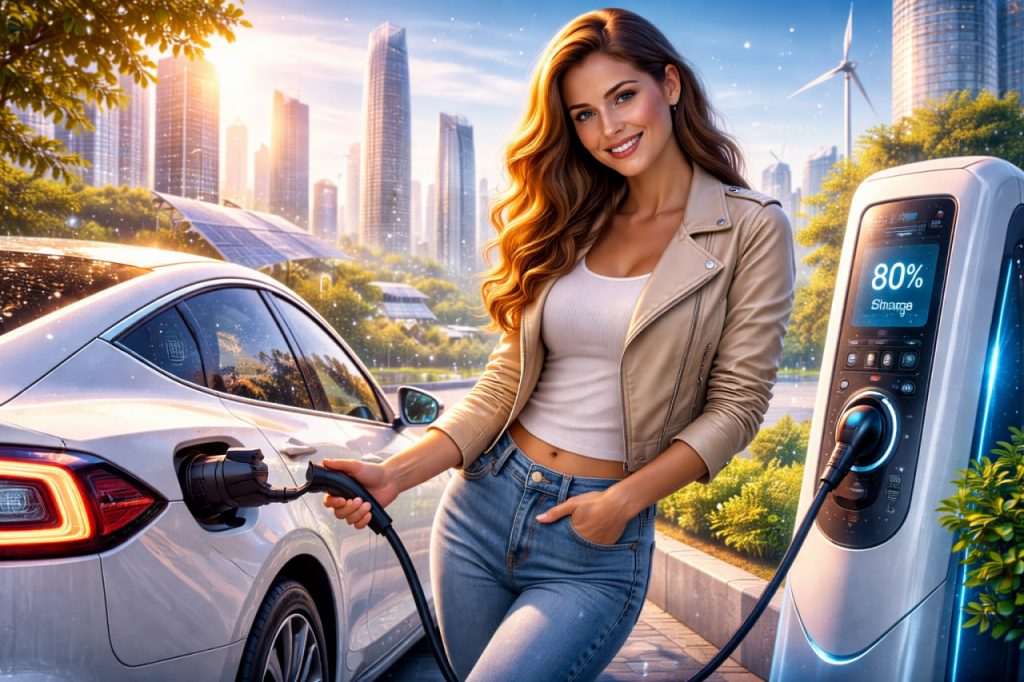
The electric car is no longer an experiment or a niche alternative to traditional vehicles—it is becoming a central pillar of future transportation systems. What lies ahead for electric vehicles (EVs) is not a single breakthrough, but a convergence of technologies, infrastructure, policy, and user behavior. The future of the electric car will be shaped less by the question “Can it replace combustion cars?” and more by “How deeply can it integrate into energy, digital, and urban ecosystems?” Understanding this future requires looking at technology, economics, and society together.
Batteries: From Incremental Gains to Structural Change
The most critical factor in the future of EVs remains the battery. In the short term, progress will continue through incremental improvements: higher energy density, faster charging, longer lifespan, and lower costs. Lithium-ion technology will dominate for years, but its architecture is evolving toward structural batteries, cell-to-pack, and cell-to-body designs that reduce weight and complexity.
In the medium term, solid-state batteries promise higher safety and energy density, though large-scale manufacturing challenges remain. Rather than a sudden replacement, the future will likely involve multiple battery technologies coexisting, optimized for different vehicle segments and use cases.
“The future of batteries is architectural, not just chemical,” — Dr. Elena Rossi, electric powertrain researcher.
Charging: From Infrastructure to Intelligence
Charging infrastructure will expand rapidly, but its true transformation lies in smart charging, vehicle-to-grid (V2G), and grid integration. Electric cars will increasingly charge when electricity is cheapest and cleanest, often without driver intervention. Homes, workplaces, and cities will treat EVs as flexible energy assets rather than passive loads.
Fast charging will improve, but everyday charging will become more invisible and automated. The question will shift from “Where can I charge?” to “Why would I think about charging at all?”
Software-Defined Vehicles and Continuous Evolution
Electric cars are inherently software-defined vehicles, meaning their behavior can change after purchase through updates. Future EVs will receive continuous improvements in efficiency, safety, user experience, and even driving dynamics. This fundamentally alters the ownership model: cars will age digitally rather than mechanically.
Advanced driver-assistance systems, predictive maintenance, and personalized energy management will become standard. Over time, the boundary between car, device, and energy system will blur.
“Electric cars are becoming platforms that evolve over time, not fixed products,” — Dr. Marcus Lee, mobility systems analyst.
Manufacturing and Cost Transformation
As EV production scales, manufacturing will undergo deep simplification. Skateboard platforms, gigacasting, modular electronics, and reduced part counts will lower costs and increase consistency. Electric cars will eventually reach cost parity with combustion vehicles without subsidies, driven by manufacturing efficiency rather than battery chemistry alone.
This shift will also reshape supply chains, reducing dependence on complex mechanical components and increasing the importance of software, power electronics, and materials science.
Environmental and Energy System Impact
The environmental future of electric cars depends on how electricity is produced. As grids transition toward renewables, EVs become progressively cleaner over their lifetime. Beyond emissions, EVs reduce urban noise, enable better air quality, and support energy system stability through storage and load balancing.
Electric cars will increasingly be evaluated not as isolated products, but as nodes in a larger energy network.
Autonomy and Mobility Models
While full autonomy remains uncertain in timing, partial automation will continue to improve safety and reduce driver workload. Electric platforms are particularly well-suited for autonomy due to precise motor control and centralized electronics.
At the same time, the future of EVs includes new ownership and usage models: car sharing, fleets, autonomous taxis, and purpose-built vehicles for logistics or services. Personal ownership will remain important, but it will no longer be the only dominant model.
Challenges That Will Shape the Future
Despite optimism, challenges remain. Raw material sourcing, recycling, grid capacity, and equitable access to charging must be addressed. Workforce transformation and consumer education are equally important. The future of electric cars is not guaranteed by technology alone—it depends on coordinated progress across industries and governments.
“The transition to electric mobility is as much a social transformation as a technological one,” — Dr. Laura Jensen, transportation policy expert.
Will Electric Cars Fully Replace Combustion Vehicles?
In most regions, yes—but gradually. Combustion vehicles will persist in niche roles and legacy markets for decades. However, for mainstream passenger transport, electric cars represent the most efficient, adaptable, and scalable solution available. The question is no longer if they will dominate, but how fast and how well the transition is managed.
Conclusion
The future of the electric car is not defined by a single invention, but by integration. EVs will become cheaper, smarter, cleaner, and more deeply connected to energy and digital systems. As batteries, software, and infrastructure evolve together, electric cars will shift from being an alternative choice to the default foundation of personal mobility. Their future is not just electric—it is systemic, adaptive, and inseparable from the future of modern society.


I believe best direction that EV’s can take is public transportation. Rather than having your target audience day by day regular consumer, it would be much efficent for both enviromental reasons and making the EV’s a default choice for transportation purposes is to endorse EV public transportation in countries. As more and more counties, cities, especially districts where governor rules out public transportation costs, endorsing such method would be much better. Since companies love to use government subsidieries and tax payers money, that would also be cost efficient for them xD
I would also like to add that I totally agree with ”Combustion vehicles will persist in niche roles and legacy markets for decades.” CV’s will be, in foreseeble future, a vintage luxury item due to CV’s having that old school, powerful feeling, with a roaring engine.
Just yapping again… where the ACTUAL dev work at tho?🥱
Well😀😀, if you are really going to develop this, Im all for it!