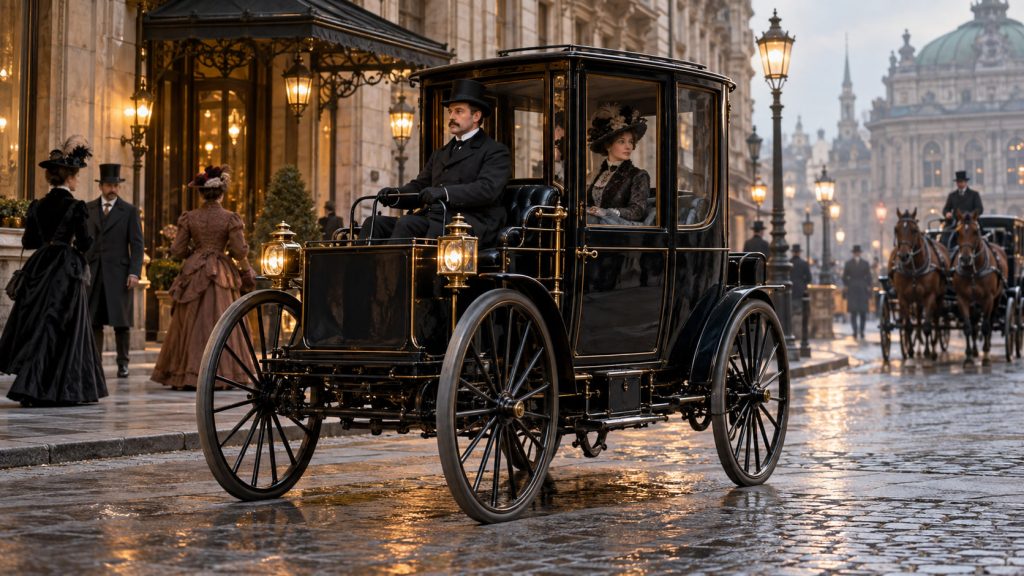
Electric cars are often described as a modern response to climate change, battery breakthroughs, and increasingly strict emissions regulations. In reality, the electric automobile is almost as old as the automobile itself.
Long before lithium-ion batteries, rapid chargers, regenerative braking, or software-controlled electric motors existed, engineers were already experimenting with battery-powered road vehicles. By the final decades of the 19th century, electric propulsion was competing directly with steam and gasoline.
For a brief period, electricity even appeared to have several decisive advantages. Electric cars were quiet, relatively clean at the point of use, easy to start, and simple to operate. Gasoline cars, by comparison, were noisy, mechanically demanding, difficult to start, and often unpleasant to drive.
Yet the internal-combustion automobile ultimately dominated the 20th century.
Electric cars did not disappear because the basic idea was defective. They lost because battery technology, infrastructure, manufacturing economics, road development, and the rapidly improving gasoline car all moved in the wrong direction for early EVs at the same time.
Understanding that first electric-car era helps explain why today’s EV revolution required more than simply replacing an engine with a motor.
The Electric Car Began Before the Modern Automobile
There is no single universally accepted inventor of the first electric vehicle because several engineers experimented with electric propulsion during the 19th century.
Early electrically powered carriages appeared in experimental form during the 1830s. These machines were extremely primitive by modern standards and depended on non-rechargeable batteries, making them unsuitable as practical transportation.
A crucial breakthrough arrived in 1859, when French physicist Gaston Planté invented the rechargeable lead-acid battery.
For the first time, electrical energy could be stored in a battery that could be recharged repeatedly rather than discarded after use.
The technology improved further when Camille Alphonse Faure developed a more practical method of manufacturing lead-acid batteries in the early 1880s, increasing their capacity and making larger rechargeable battery systems more commercially realistic.
Electric motors were also improving.
By the final decades of the century, these advances began converging with another technological revolution: the automobile.
What a 19th-Century Electric Car Was Actually Like
An early electric automobile was fundamentally simpler than a gasoline vehicle.
A battery pack supplied direct-current electricity to an electric motor. A controller regulated how much electrical power reached the motor, allowing the driver to control speed.
There was no gasoline engine, carburetor, exhaust system, ignition timing, or hand-crank starting procedure.
The batteries were normally lead-acid units. These were robust and rechargeable, but extremely heavy for the amount of energy they stored.
That created the defining limitation of early electric cars.
A large battery provided more range, but the additional battery mass increased vehicle weight. That required more energy to move, while placing additional loads on tires, brakes, suspension, and the structure itself.
Nevertheless, electric power had several immediate advantages.
Electric motors produced useful torque from a standstill. They operated quietly. They generated no exhaust fumes at the vehicle. They also required much less mechanical skill to operate than many early combustion engines.
At the end of the 19th century, an electric automobile could actually feel more civilized and technologically sophisticated than a gasoline car.
The First Practical American Electric Cars
Electric vehicles began appearing seriously in the United States near the end of the 19th century.
One important pioneer was William Morrison, a Scottish-born chemist living in Iowa. Around 1890, Morrison developed an electric vehicle that is widely regarded as one of the first successful electric automobiles in the United States.
His machine was closer to an electrified carriage than a modern car. It could carry several passengers and used rechargeable batteries to power an electric motor.
Its importance was not primarily commercial. It demonstrated that an electric road vehicle could be practical enough to transport people without rails, horses, or a steam boiler.
Other inventors quickly expanded the idea.
Pedro Salom and Henry Morris developed the Electrobat in Philadelphia during the 1890s. Their vehicles became progressively lighter and more sophisticated and were used in early electric taxi operations.
Electric taxicabs appeared in New York City before the end of the century, demonstrating one of the earliest commercial uses for battery-powered automobiles.
Europe Was Experimenting with Electricity Too
Electric vehicle development was not limited to the United States.
European engineers were also exploring battery-powered transportation.
British inventor Thomas Parker, known for his work with electrical equipment and urban transportation, developed electric vehicles during the 1880s.
In continental Europe, manufacturers and engineers experimented with increasingly sophisticated electric drivetrains as automobile technology developed.
A young Ferdinand Porsche also worked on electric vehicles before becoming associated with the sports-car company that later carried his name.
The 1898 Egger-Lohner electric vehicle associated with Porsche is one of the best-known examples from the period. Soon afterward, Porsche developed electric wheel-hub motors and experimented with a gasoline-electric hybrid system.
This is a remarkable reminder that battery-electric and hybrid automotive concepts were already being explored before the 20th century had properly begun.
An Electric Car Became the First Vehicle to Break 100 km/h
One of the most dramatic demonstrations of electric propulsion arrived in 1899.
Belgian driver and engineer Camille Jenatzy drove the electrically powered La Jamais Contente to more than 100 kilometers per hour.
Its streamlined body looked radically different from conventional horse-carriage-inspired automobiles of the period.
In April 1899, Jenatzy reached approximately 105.9 km/h, or 65.8 mph, making La Jamais Contente the first road vehicle officially credited with exceeding 100 km/h.
The achievement is historically significant because it contradicts the assumption that early electric vehicles were inherently slow.
At the end of the 19th century, an electric vehicle held the absolute land-speed record.
Gasoline technology would eventually provide much greater speed and range, but that outcome was not obvious in the 1890s.
Why Electric Cars Looked So Promising Around 1900
The gasoline automobile of the late 19th century had serious disadvantages.
Starting one could require considerable physical effort. The driver often had to turn a hand crank at the front of the car. If performed incorrectly, the crank could kick back violently and cause injury.
Engines vibrated, leaked fluids, produced exhaust fumes, and required frequent mechanical attention.
Manual transmissions were crude and demanded greater skill than the controls of an electric car.
Electric automobiles avoided many of these problems.
They were particularly well suited to urban journeys, where distances were limited and charging could be arranged at homes, garages, hotels, or commercial facilities with electricity.
The U.S. Department of Energy’s historical account of electric vehicles notes that around 1900, electric cars represented approximately 38 percent of automobiles in the United States, compared with about 22 percent for gasoline vehicles and roughly 40 percent for steam.
The exact historical totals depend on how vehicles were counted, but the broader picture is clear: gasoline was not yet the inevitable winner.
Electricity was a serious competitor.
Early EVs Also Found an Ideal Customer Base
Many early manufacturers marketed electric cars to wealthy urban customers.
Companies such as Baker Electric, Columbia, and later Detroit Electric became associated with quiet, elegant personal transportation.
Electric automobiles were sometimes marketed particularly strongly toward women, partly because they avoided hand cranking and complicated gear changes.
That marketing reflected the social attitudes of the period, but it also exposed a genuine technical advantage: electric cars required considerably less physical interaction with the drivetrain.
Some prominent owners adopted electric vehicles. Detroit Electric later attracted customers ranging from wealthy urban families to well-known public figures.
For city driving, the formula worked.
The vehicle could leave a private garage, travel around town, and return to the same location for charging.
Unfortunately for electric-car manufacturers, the automobile was about to change from an urban luxury into a long-distance mass-market product.
Batteries Were the Fundamental Technical Weakness
The lead-acid battery made practical electric cars possible, but it also limited them.
Modern lithium-ion cells store several times more energy per kilogram than traditional lead-acid technology.
The batteries available to 19th-century EV designers were therefore heavy and bulky relative to the energy they contained.
Early electric cars commonly had practical ranges suited to local urban travel rather than long journeys. Exact figures varied considerably between vehicles and conditions, but ranges of several dozen miles were typical.
That was sufficient when streets were crowded, roads between cities were poor, and many automobile journeys were short.
It became a much greater disadvantage as motorists wanted to travel farther.
A gasoline car could carry a relatively small tank containing a large amount of usable energy. Refueling could eventually be completed quickly.
Increasing the range of an electric car meant carrying substantially more battery mass.
Early electric mobility faced the same fundamental challenge as modern EVs, but with battery technology dramatically less capable than today’s.
Electricity Was Available in Cities, but Not Everywhere
Another disadvantage was infrastructure.
Electric lighting and power networks expanded rapidly around the turn of the century, but electrification was far from universal.
Cities were the natural environment for electric automobiles because electricity was increasingly available there.
Rural areas were another matter.
In the United States, widespread rural electrification would not arrive until decades later. A gasoline car could travel into areas where no useful electrical supply existed, provided the driver could obtain fuel.
Gasoline distribution also became increasingly convenient as car ownership expanded.
Hardware stores, garages, and eventually dedicated filling stations supplied fuel. Liquid gasoline could be transported and stored relatively easily.
The gasoline automobile therefore became better suited to the expanding geography of motor travel.
Roads Improved, and Drivers Wanted More Range
At first, limited EV range was less problematic because early roads themselves restricted long-distance travel.
As road networks improved, the automobile’s purpose changed.
Cars were no longer merely alternatives to horse-drawn carriages for movement within cities. They became tools for traveling between towns, exploring rural areas, touring, and eventually commuting over much larger distances.
This shift favored gasoline.
If two cars were equally useful around town but one could continue for much greater distances and be refueled rapidly, consumers increasingly had a reason to choose the longer-range machine.
The expanding road network effectively turned range from a secondary feature into a central competitive advantage.
The Model T Changed the Economics of the Automobile
Perhaps the most important commercial blow to early electric cars came from mass production.
Ford introduced the Model T in 1908.
The Model T was not the first gasoline automobile, nor was it initially the cheapest possible vehicle. Its revolutionary impact came from Ford’s relentless development of standardized manufacturing and moving assembly-line production.
As production expanded, the Model T became dramatically cheaper.
Ford reduced prices repeatedly during the car’s long production run, placing automobile ownership within reach of a much broader section of society.
Electric cars remained relatively expensive, partly because batteries were costly and production volumes were smaller.
The EV was competing not merely against the gasoline engine, but against one of the most successful manufacturing systems in industrial history.
Once the automobile became a true mass-market product, manufacturing cost mattered enormously.
The Electric Starter Removed a Major Gasoline-Car Weakness
Gasoline cars also improved rapidly.
One of their most important shortcomings was the starting process.
The hand crank was inconvenient and potentially dangerous. That gave electric cars a major usability advantage because they did not need manual engine cranking.
Then Charles Kettering developed a practical electric starting system.
Cadillac introduced an electric starter on its 1912 models.
The improvement was transformative.
Drivers could start a gasoline engine electrically instead of leaving the cabin and turning a crank.
Ironically, electric technology helped make the gasoline car easier to use and therefore helped remove one of the early EV’s strongest competitive advantages.
Gasoline vehicles also gained better transmissions, improved engines, more reliable ignition systems, pneumatic tires, stronger brakes, and better overall reliability.
The technological gap in convenience rapidly narrowed.
Cheap Oil Strengthened Gasoline’s Position
Fuel economics also changed.
Major petroleum discoveries, including the spectacular Spindletop oil strike in Texas in 1901, helped support rapidly expanding American petroleum production.
Refining and distribution systems became more sophisticated.
Gasoline, once partly regarded as a byproduct of refining processes focused on products such as kerosene, became enormously valuable as motor vehicle ownership increased.
A self-reinforcing system emerged.
More gasoline cars created demand for more filling stations. More filling stations made gasoline cars more convenient. Greater convenience encouraged more people to buy gasoline vehicles.
Electric vehicles struggled to create an equivalent network.
Early EVs Did Not Suddenly Vanish
It is important not to simplify the history too much.
Electric cars did not lose the market in one dramatic moment, nor did gasoline automobiles defeat them during the 19th century itself.
The competitive shift occurred mainly during the early decades of the 20th century.
Companies continued producing electric passenger cars for years. Detroit Electric, for example, remained active well beyond the first automobile boom.
Electric propulsion also continued in specialized transportation.
Trams, trolleybuses, railways, industrial vehicles, delivery vehicles, and other machines demonstrated that electric motors remained exceptionally useful.
What largely disappeared was the mainstream battery-electric private passenger car.
By the 1920s, gasoline had become dominant.
Why Gasoline Ultimately Won
No single invention killed the first electric-car era.
Instead, several forces reinforced one another:
- Lead-acid batteries had poor energy density.
- Electric cars offered limited long-distance range.
- Charging infrastructure was geographically restricted.
- Electricity was not universally available outside urban areas.
- Gasoline could be transported and dispensed quickly.
- Petroleum production expanded.
- Road improvements increased demand for long-distance travel.
- The electric starter made gasoline cars easier to operate.
- Internal-combustion engines became more reliable.
- Mass production dramatically reduced gasoline-car prices.
Together, these developments changed what buyers expected from a car.
The market increasingly rewarded range, low purchase price, rapid refueling, and freedom to travel beyond electrified cities — exactly the areas where gasoline vehicles had become strongest.
What Modern EVs Changed
Today’s electric vehicles solve many of the limitations that defeated their ancestors.
Lithium-ion batteries store far more energy for a given weight than 19th-century lead-acid batteries. Modern power electronics control motors with extraordinary efficiency. Regenerative braking recovers part of the vehicle’s kinetic energy.
Public rapid-charging networks allow long-distance travel, while millions of drivers can charge at home.
Modern EVs can travel hundreds of kilometers on one charge, accelerate faster than many high-performance combustion cars, and operate with sophisticated thermal-management systems that early inventors could scarcely have imagined.
The electricity network has also changed.
Unlike the partially electrified world of 1900, modern industrialized societies depend on extensive electrical infrastructure.
Perhaps most importantly, economics are moving in a direction that early EV pioneers never experienced. Battery costs have fallen dramatically over the modern EV era, while large manufacturers now produce electric vehicles at industrial scale.
Conclusion
The electric cars of the 19th century were not crude failures waiting to be replaced by superior gasoline technology. For a period, they represented one of the most promising paths for the emerging automobile.
They were quiet, mechanically simple, easy to operate, free from local exhaust emissions, and capable of impressive performance. In 1899, an electric car became the first automobile to exceed 100 km/h. Around the turn of the century, electric cars held a substantial share of the young American automobile market.
Their defeat came later.
Heavy lead-acid batteries restricted range. Electricity remained concentrated in urban areas. Improved roads encouraged longer journeys. Petroleum became abundant, gasoline distribution expanded, and Ford-style mass production made combustion cars increasingly affordable.
Most critically, gasoline vehicles improved quickly enough to eliminate many of their original disadvantages. The electric starter, better engines, improved transmissions, and greater reliability transformed them from difficult mechanical machines into practical consumer products.
The first electric-car era was therefore not defeated because electric propulsion was fundamentally inferior. It was defeated because the surrounding technological and economic system evolved faster in favor of gasoline.
More than a century later, that system is changing again. Batteries are vastly better, electricity is nearly universal in developed markets, charging networks are expanding, and electric motors have returned to the center of automotive development.
The modern EV revolution is not the birth of the electric car. It is the second major attempt to make one of the automobile industry’s oldest ideas commercially dominant.