Electric vehicles promise quieter driving, lower local emissions, fewer routine mechanical maintenance requirements and increasingly sophisticated driver-assistance technology. But the transition to electric mobility will only be successful if electric cars are practical for everyone, including drivers and passengers with disabilities.
That is a substantial part of the population. The World Health Organization estimates that more than 1.3 billion people, roughly 16 percent of the global population, experience significant disability. Their mobility requirements vary enormously. Some people use wheelchairs, while others have limited hand strength, restricted movement, reduced vision or hearing, chronic pain, short stature, neurological conditions or other needs that affect vehicle access and operation.
Electric cars can offer genuine accessibility advantages, but they can also introduce new obstacles. Heavy charging cables may be difficult to handle. Touchscreen-heavy interiors can make basic controls harder to use. Battery packs installed beneath the floor can complicate wheelchair-accessible conversions.
The good news is that accessible electric vehicles are beginning to move from aftermarket experimentation toward a more fundamental principle: designing accessibility into an EV from the beginning rather than trying to add it after the vehicle has been completed.
Why Electric Vehicles Can Be Good for Disabled Drivers
Electric propulsion does not automatically make a vehicle accessible, but several characteristics of EVs can work particularly well for drivers with certain disabilities.
Almost every modern electric passenger car uses a simple automatic-style transmission. There is no clutch pedal and normally no need for manual gear changes. That can reduce the physical workload for drivers who have limited leg movement or coordination.
Regenerative braking can also allow the vehicle to slow substantially when the accelerator is released. Some EVs offer adjustable regeneration or strong one-pedal driving modes. For an appropriate driver, this may reduce how frequently conventional braking is required.
It is important, however, not to assume that one-pedal driving is suitable for every disability. Individual control requirements should be assessed professionally.
Electric motors also provide smooth power delivery without conventional gear changes. Climate preconditioning is another potentially useful feature. Many EVs can heat or cool the cabin before a journey, often while still connected to external power. This can be particularly valuable for people whose medical condition makes temperature regulation difficult.
Remote unlocking, powered tailgates, electrically adjustable seats and automated parking can further reduce physical effort.
The best accessible technology is often technology that removes small repetitive difficulties from every journey.
Accessibility Means Much More Than Wheelchair Access
Discussions about accessible vehicles frequently focus on wheelchair users, but disability encompasses a much broader range of requirements.
A driver with reduced hand strength may need steering adaptations and controls that require very little force. Someone with limited leg movement might need hand-operated acceleration and braking. Another driver may require a left-foot accelerator.
Passengers may need swivel seats, transfer aids, grab handles or hoists for mobility equipment. Someone with low vision may need physical controls that can be identified by touch. A deaf driver may benefit from strong visual warnings rather than systems that rely predominantly on audio alerts.
This is why there cannot be one universally perfect “disabled person’s EV.”
Accessibility has to include the vehicle’s doors, seats, controls, visibility, storage, charging port, digital systems and compatibility with aftermarket adaptations.
A car can have an enormous touchscreen and impressive autonomous technology yet remain frustratingly inaccessible if opening the glovebox requires navigating several menus.
Wheelchair-Accessible Electric Vehicles Remain a Special Challenge
Wheelchair Accessible Vehicles, commonly known as WAVs, present one of the toughest engineering problems in the transition from combustion vehicles to battery-electric cars.
Conventional WAV conversions may require substantial structural modifications. The floor can be lowered to create additional headroom, while ramps, lifts, wheelchair restraints and docking equipment may require secure mounting points underneath or through the floor.
That becomes significantly more difficult in many EVs because the traction battery occupies exactly that space.
The Energy Saving Trust, in research commissioned by the Motability Foundation, identified battery location as a major accessibility issue. Its work found that disabled people’s requirements were not being sufficiently considered in EV design and that the position of batteries can restrict or prevent adaptations, particularly in smaller wheelchair-accessible vehicles.
The same research found considerable interest in electric WAVs. More than 70 percent of surveyed WAV users had considered driving an electric WAV, while limited availability of suitable vehicles was identified by 85 percent of respondents as a significant barrier.
Putting a battery beneath the cabin is excellent for vehicle dynamics, but it can occupy the space accessibility specialists traditionally use to modify a vehicle.
Drilling into an EV floor is also fundamentally different from drilling into an ordinary metal floor because a high-voltage battery pack may be directly underneath it.
Purpose-Built Accessible EVs Could Change the Market
The ideal solution is therefore not always a better conversion. In some cases, it is a vehicle designed around accessibility from the beginning.
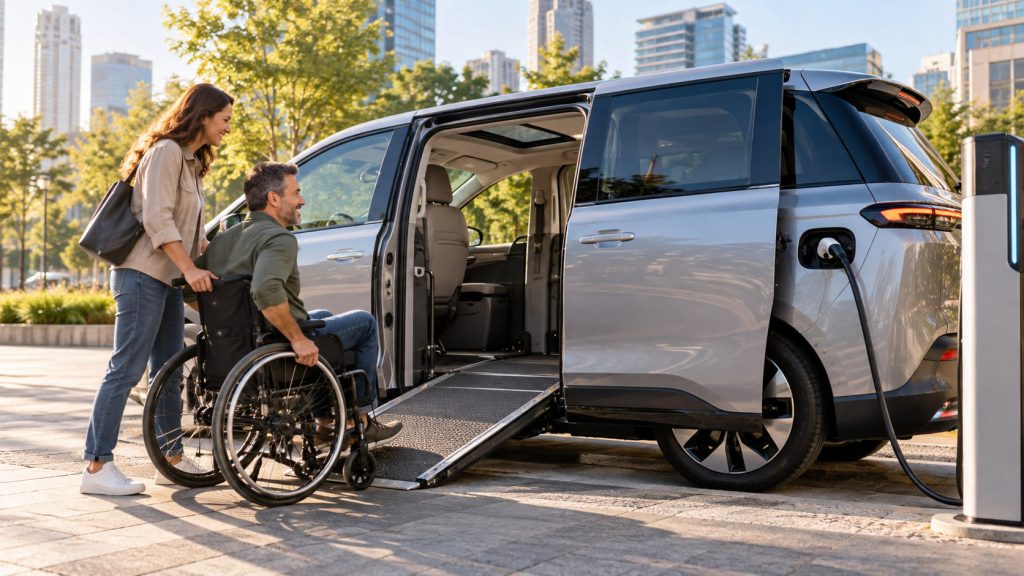
The Kia PV5 WAV provides an important example of this direction. Developed as part of Kia’s electric Platform Beyond Vehicle family for 2026, the wheelchair-accessible version integrates accessibility into the vehicle architecture rather than treating it purely as a later aftermarket modification.
Kia designed it with a side-entry system and an in-floor two-stage manual ramp. The company specifies a side-door opening approximately 775 millimeters wide and a wheelchair area with around 1,398 millimeters of interior height. The ramp can be configured differently for entry from a kerb or ground level.
The wheelchair and its occupant use separate restraint systems, while flexible seating allows a companion to remain nearby.
Kia quotes up to 391 kilometers of WLTP driving range and approximately 30 minutes for a 10-to-80-percent rapid charge under suitable conditions. Exact specifications and availability vary by market.
The vehicle is significant not because it will meet every user’s requirements, but because it demonstrates another development path.
When accessibility is incorporated into the original EV platform, engineers can design battery placement, doors, floor structure, seating and restraints as one system.
That is much more promising than asking conversion specialists to solve every problem after production.
Vehicle Adaptations Still Have an Essential Role
Purpose-built wheelchair-accessible EVs will not eliminate the adaptation industry.
Many disabled drivers do not need a complete WAV. They may need a relatively standard electric car fitted with particular equipment.
Depending on the person and vehicle, adaptations can include:
- Hand controls for acceleration and braking
- Steering aids
- Left-foot accelerators
- Pedal extensions
- Transfer seats or swivel seats
- Wheelchair and scooter hoists
- Remote secondary controls
- Powered door or tailgate systems
- Wheelchair restraint and docking systems
Compatibility must be checked before buying the car.
An adaptation that works easily on the petrol version of a vehicle may not necessarily be approved for its electric counterpart. High-voltage cables, battery modules and structural battery protection can change where equipment may safely be attached.
Payload also matters. EV batteries are heavy, and adaptations, powered wheelchairs, passengers and equipment all contribute to total vehicle weight.
A professional mobility assessment and an experienced vehicle adaptation specialist should therefore be involved early in the purchasing process rather than after a vehicle has already been ordered.
Charging Is One of the Biggest Accessibility Problems
An accessible electric car is only part of the equation. The driver also has to charge it.
For someone with private parking and an appropriately positioned home charger, charging can actually be easier than visiting a fuel station. A vehicle can be plugged in at home and start each morning with sufficient energy for normal travel.
Public charging can be much more complicated.
Motability Foundation research has repeatedly identified barriers including heavy charging cables, the physical force required to connect plugs, unsuitable parking layouts and missing dropped kerbs.
A charger can technically work perfectly while remaining impossible to use from a wheelchair.
There must be sufficient space to open the vehicle door, deploy mobility equipment and move between the vehicle and charging unit. Kerbs and protective bollards must not block access. Screens, payment equipment and connectors must be within reachable positions.
Even the location of the charging inlet on the car matters. A charger arrangement suitable for a rear-left charging port may be awkward for a vehicle whose inlet is at the front or opposite side.
Accessible Charging Standards Are Improving
Governments and standards organizations have begun addressing the problem.
In the United Kingdom, the PAS 1899 specification was developed by the British Standards Institution with support from the Motability Foundation and the government’s Office for Zero Emission Vehicles. It provides guidance covering accessible public EV charging equipment and the surrounding environment.
In the United States, the U.S. Access Board has published detailed recommendations for accessible charging stations.
Its guidance includes enough room for people using wheelchairs and other mobility devices to move around the vehicle, accessible routes to charging equipment, reachable controls and consideration of cable and connector handling. For accessible mobility features, the guidance recommends an EV charging space at least 11 feet wide and 20 feet long alongside an access aisle at least 5 feet wide.
Communication accessibility matters too. Payment systems, displays and status indicators should not assume that every user can see a screen, hear an alert or operate small controls.
Accessible EV charging is not simply about providing a disabled parking symbol next to a charger. The entire charging process has to be independently usable.
Heavy Cables Need Better Engineering
Rapid chargers can deliver hundreds of kilowatts, but high-power charging equipment can require substantial cables and connectors.
Cable weight and stiffness are important accessibility issues for anyone with limited upper-body strength, restricted reach, arthritis or coordination difficulties.
Several technologies could improve this situation.
Cable-support systems can take part of the weight. Better connector ergonomics can reduce required grip strength. Automatic authentication can remove complicated payment procedures. Plug-and-charge technology can allow a compatible vehicle and charger to identify one another automatically.
Automated robotic connectors are also being developed, while wireless charging could eventually remove the need to handle a cable altogether.
Wireless systems are not yet a universal solution for passenger EVs, but accessibility provides a compelling reason for the industry to develop them.
A charging pad that operates automatically after the vehicle is correctly positioned could dramatically increase independence for some drivers.
Digital Technology Can Help — or Create New Barriers
Modern EVs are highly computerized, but digitalization is not automatically synonymous with accessibility.
Voice assistants can help drivers operate navigation, climate control or communications without reaching for physical buttons. Smartphone apps can remotely control charging and preconditioning.
Driver-assistance technology can reduce workload through features such as adaptive cruise control, automated parking and surround-view cameras.
Yet the same technology can create problems when manufacturers move too many basic functions into touchscreen menus.
A person with limited fine motor control may find a small touchscreen target difficult to operate. Someone with impaired vision may benefit from tactile controls that can be located without looking away from the road.
Good accessible design therefore uses multiple methods of interaction.
Physical switches, voice control, clear visual information, tactile feedback and configurable software should complement rather than unnecessarily replace one another.
Quiet EVs Must Also Be Safe for Pedestrians
The low-speed quietness of electric vehicles benefits occupants and communities, but it created an important accessibility issue for blind and visually impaired pedestrians.
Traditional combustion engines provide an obvious auditory indication that a vehicle is approaching. Electric motors can be much harder to hear at low speed.
This is why regulations in major markets now require new electric vehicles to produce artificial exterior warning sounds in relevant low-speed conditions.
These acoustic vehicle alerting systems demonstrate an important principle of inclusive mobility.
Accessibility should consider not only the driver and passengers inside the vehicle, but also the people interacting with it from outside.
How to Choose an Accessible Electric Car
The starting point should be the person’s actual daily requirements, not the EV with the longest range or the most impressive specification sheet.
Door opening dimensions, seat height, sill height and roof clearance can matter more than acceleration. Drivers who transfer from a wheelchair should physically test the seating position whenever possible.
The wheelchair, scooter or other equipment should be tested with the vehicle rather than relying purely on official cargo-capacity figures.
Charging must also be evaluated before purchase. A buyer should consider home charging, public stations commonly used on regular journeys, connector position and whether cables can be handled independently.
Range remains important, but excessive range can mean paying for a larger, heavier battery that is unnecessary for normal travel.
Adaptations should be discussed with qualified specialists before the vehicle is ordered because battery placement may affect installation possibilities.
Cost Remains a Major Accessibility Issue
Accessible mobility can already be expensive before electrification enters the equation.
A standard car may require costly controls, lifts, ramps, seats or wheelchair restraint systems. Purpose-built WAVs can require extensive engineering.
Electric vehicles add expensive battery technology, and the relatively small market for specialized accessible vehicles can make economies of scale difficult.
Financial support varies significantly between countries. Disability mobility programs, grants, tax policies and leasing schemes can substantially change the real cost to an individual.
This is another reason accessible EVs need greater production volume.
Purpose-designed platforms, standardized mounting systems and closer cooperation between manufacturers and adaptation specialists could eventually reduce costs.
Conclusion
Electric cars for people with disabilities are no longer a peripheral question for the automotive industry. With around one in six people worldwide experiencing significant disability, accessibility must be part of the transition to electric transport from the beginning.
EVs can provide real benefits: automatic operation, smooth power delivery, preconditioned cabins, advanced driver assistance and the possibility of convenient home charging. At the same time, battery placement, high floors, difficult conversions, heavy charging cables and inaccessible public infrastructure can create entirely new barriers.
Research from organizations including the Motability Foundation and Energy Saving Trust has made the central problem clear: disabled people cannot simply be expected to adapt to vehicles and charging networks that were designed without them in mind.
The emergence of purpose-designed vehicles such as the Kia PV5 WAV shows that a different approach is possible. Future electric vehicles can integrate wheelchair access, adaptable interiors, accessible controls and suitable charging solutions at the engineering stage rather than treating accessibility as an aftermarket problem.
The same principle applies to charging infrastructure. Wider bays, level access, manageable cables, reachable controls, accessible payment systems and future technologies such as automated or wireless charging can make electrification genuinely independent.
The most successful accessible electric vehicle will not be the one with the most specialized equipment. It will be the one that allows its user to enter, drive, charge and travel with as little unnecessary assistance as possible.