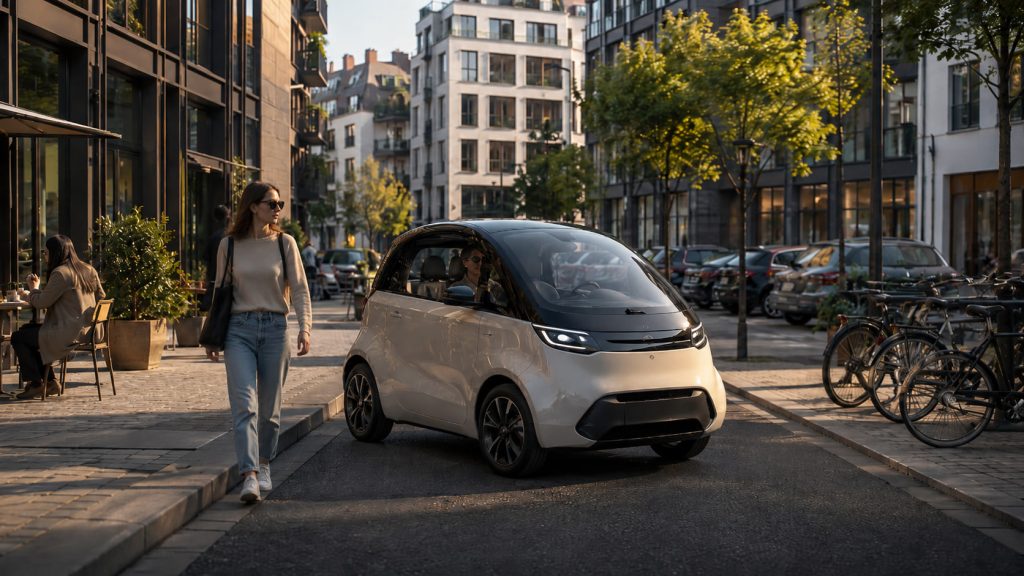
Cities were not designed for millions of large vehicles carrying one person at a time. Yet that is exactly how much urban transportation works today. A conventional car may weigh well over a ton, occupy several square meters of road space, and spend most of its life parked, even when its daily task is little more than moving one person a few miles through congested streets.
That mismatch is driving renewed interest in urban microcars: ultra-compact vehicles designed specifically for short trips, dense streets, limited parking, and low-speed environments.
They sit somewhere between motorcycles, scooters, and conventional passenger cars. Some offer doors, roofs, heating, and weather protection. Others emphasize extreme efficiency and minimal weight. Electric powertrains make the concept especially attractive because compact motors and small battery packs can be packaged into very short vehicles without the constraints of a conventional engine and transmission.
Models such as the Citroën Ami, Fiat Topolino, Microlino, Silence S04, and Mobilize Duo demonstrate that the idea is no longer limited to motor-show prototypes. At the same time, numerous concepts from major automakers show how much further microcars could evolve.
The future of personal urban transportation may not be one universal replacement for the car. It may be a broader ecosystem in which compact electric vehicles handle the trips that full-size automobiles perform inefficiently today.
What Is an Urban Microcar?
There is no single global definition.
Depending on the market, compact urban vehicles may be legally classified as quadricycles, neighborhood electric vehicles, low-speed vehicles, microcars, or small passenger cars.
The common characteristics are easier to identify.
Most urban microcars are:
- Much shorter and narrower than conventional cars
- Designed primarily for one or two occupants
- Optimized for short urban journeys
- Powered by small electric drivetrains
- Equipped with modest battery capacity
- Limited to relatively low speeds
- Easier to park in dense areas
- Lighter than mainstream passenger vehicles
A typical microcar does not attempt to compete with a family SUV on a motorway.
That is the point.
Instead of designing every personal vehicle for the most demanding trip an owner might take once a year, a microcar is optimized for the journeys people make every day.
Electric Power Makes Microcars More Practical
Tiny combustion-powered cars have existed for decades, but electric propulsion changes their engineering dramatically.
A traditional powertrain requires an engine, transmission, exhaust system, fuel tank, cooling system, and multiple mechanical accessories. All of that becomes difficult to package inside a vehicle that may be little more than two meters long.
An electric drivetrain is considerably simpler.
A small motor can be placed near an axle. A compact battery can sit beneath the floor. There is no exhaust system, no conventional gearbox, and no large engine bay.
That allows designers to use more of the vehicle’s external dimensions for passengers.
The smaller the vehicle becomes, the more valuable the packaging advantages of an electric drivetrain become.
Battery requirements can also be modest.
A vehicle intended primarily for urban commuting does not necessarily need hundreds of miles of range. A relatively small battery can provide enough energy for several days of short trips while keeping cost and weight under control.
The Citroën Ami Demonstrated the Appeal of Radical Simplicity
The Citroën Ami became one of the most recognizable modern examples of the microcar idea.
It is intentionally basic.
The vehicle is short, narrow, electric, and designed around low-speed urban transportation rather than traditional automotive performance. Its unusual symmetrical design also reduces manufacturing complexity: several exterior components are shared between different sides or ends of the vehicle.
This approach reveals an important principle.
Microcars become more compelling when manufacturers stop treating them as miniature conventional cars.
Trying to reproduce the equipment, performance, crash structure, range, and refinement of a larger vehicle in an extremely small package can quickly make the product too expensive.
The Ami instead accepts its limitations and focuses on simplicity.
That makes it closer to a mobility device than a conventional small hatchback.
Microlino Takes Inspiration from Bubble Cars
The Microlino approaches urban mobility from another direction.
Its design recalls the tiny bubble cars of the 1950s, particularly with its front-opening door and extremely compact proportions. But underneath the retro appearance is a modern electric urban vehicle.
Its appeal lies in occupying the space between two-wheel transportation and a normal car.
A driver receives:
- A roof
- Enclosed seating
- Weather protection
- Luggage space
- Four wheels
- Electric propulsion
Yet the vehicle occupies far less road and parking space than a conventional automobile.
This middle category could become increasingly important.
Many people do not want to ride a motorcycle or scooter in bad weather, carry groceries on a bicycle, or give up the feeling of an enclosed cabin. At the same time, they may not need a conventional car for most urban journeys.
Microcars attempt to fill exactly that gap.
Mobilize Duo Shows How Shared Mobility Could Shape Microcars
Renault Group’s Mobilize brand developed the Duo with urban mobility services in mind.
Its narrow body, two-seat layout, compact dimensions, and simplified construction reflect a different business model from that of the traditional privately owned car.
Shared vehicles face unique challenges.
They must be:
- Easy to clean
- Durable
- Simple to operate
- Easy to repair
- Efficient in dense traffic
- Resistant to frequent use
This can influence every design decision.
A privately owned premium car might prioritize soft materials, extensive personalization, and maximum comfort. A shared microcar may prioritize replaceable panels, washable surfaces, simple controls, and low operating costs.
The microcar may therefore develop not only as a new vehicle type, but also as a new ownership model.
Silence S04 Explores Removable Batteries
One of the most interesting urban-mobility solutions comes from vehicles designed around removable batteries.
The Silence S04 uses compact battery modules that can be removed from the vehicle and transported separately.
This addresses one of the biggest barriers to urban EV ownership.
Many city residents live in apartments without private parking or access to a dedicated charger.
A removable battery allows the energy-storage system to be separated from the vehicle.
Instead of bringing the car to electricity, the owner can potentially bring the battery to a charging location.
The idea is particularly useful for smaller vehicles because their energy requirements are low enough for battery modules to remain manageable.
Large EV batteries cannot realistically be carried into an apartment. Microcar batteries can be designed around much smaller modules.
Why Cities Could Benefit from Smaller Vehicles
Urban microcars are often presented primarily as environmentally friendly vehicles, but their largest advantage may actually be spatial efficiency.
Road space is limited.
Parking space is limited.
Urban land is expensive.
A shorter and narrower vehicle can use all three more efficiently.
If two microcars can occupy the parking length normally required by one large vehicle, the impact can become significant when multiplied across thousands of spaces.
Narrow vehicles can also reduce the physical footprint of traffic.
This does not mean cities should simply replace every conventional car with a microcar. Walking, cycling, buses, rail, and other forms of public transportation can move people even more efficiently.
But there are many journeys where a small enclosed vehicle could complement those modes.
Examples include:
- Commuting several miles
- Carrying groceries
- Visiting multiple locations
- Transporting equipment
- Traveling during poor weather
- Providing mobility for people unable to cycle
- Making short business trips
A microcar makes the most sense when it replaces a larger car, not when it replaces walking or public transport.
Weight May Matter as Much as Battery Technology
The modern EV industry often focuses on energy density and charging speed.
Microcars offer another route to efficiency: simply move less mass.
A lighter vehicle requires less energy during acceleration and usually less energy overall.
It also needs a smaller battery.
That smaller battery further reduces weight.
The cycle continues.
A large electric SUV may require a battery weighing several hundred kilograms to deliver the range customers expect. An urban microcar can achieve useful daily mobility with a fraction of that energy storage.
This can reduce demand for battery materials per vehicle.
It can also lower manufacturing cost.
For urban transportation, improving efficiency through lower mass may be more elegant than continuously increasing battery capacity.
Smaller Vehicles Could Transform Parking
Parking is one of the least glamorous but most important reasons microcars could succeed.
Modern cities devote enormous amounts of valuable land to storing vehicles that are not being used.
Microcars can change the geometry.
Some compact concepts are narrow enough to fit into spaces that would be unusable for ordinary cars. Others can park more efficiently because of their very short length.
Future designs could push this further.
Vehicles could use:
- Extremely tight turning circles
- Four-wheel steering
- Sideways parking assistance
- Automated parking
- Remote-control maneuvering
- Compact charging bays
As autonomous parking technology improves, microcars may be able to use spaces that would be difficult for a driver to access manually.
Microcars Are Not Automatically Safe
The strongest criticism of microcars concerns crash protection.
Vehicle size and mass matter during collisions.
A very light microcar interacting with a large SUV or truck faces an obvious disadvantage.
Legal classifications also differ substantially.
Some quadricycles are not required to meet the same crash regulations as conventional passenger cars.
This does not mean microcars are inherently unsafe, but buyers must understand that a four-wheeled enclosed vehicle does not necessarily provide the same crash protection as a full-size passenger car.
Manufacturers can improve safety through:
- Strong passenger cells
- Energy-absorbing structures
- Airbags
- Electronic stability control
- Automatic emergency braking
- Speed limitations
- Better visibility
- Collision-avoidance technology
However, physics cannot be completely eliminated.
This is one reason microcars are most suitable for low-speed urban environments rather than high-speed mixed traffic.
Experts Increasingly Focus on Vehicle Size and Weight
Transportation researchers have repeatedly emphasized that electrification alone does not solve every problem associated with cars.
The International Transport Forum, an intergovernmental organization within the OECD system, has examined the implications of growing vehicle size and weight and has highlighted how heavier vehicles can increase energy use, road wear, and safety risks for other road users.
That perspective is highly relevant to microcars.
An electric vehicle can eliminate tailpipe emissions while still being unnecessarily large for its purpose.
From an efficiency standpoint, replacing a large combustion car with a large electric car is an improvement in many areas.
Replacing an oversized vehicle used primarily for short urban trips with a compact electric microcar may go further by reducing both energy demand and spatial consumption.
The expert debate is therefore shifting from simply asking how vehicles are powered to asking how much vehicle people actually need.
Autonomous Driving Could Make Microcars More Important
Autonomous technology could have an especially strong impact on compact urban vehicles.
A self-driving microcar would not necessarily need the same interior design as a conventional automobile.
Controls could become simpler.
Seating could be optimized for short trips.
Fleet operators could redistribute vehicles automatically according to demand.
An autonomous microcar could:
- Pick up a passenger
- Complete a short urban journey
- Travel to the next customer
- Recharge automatically
- Reposition itself overnight
Because most urban trips carry only one or two people, operating a large autonomous vehicle for every journey would waste energy and road space.
A fleet containing different vehicle sizes could dispatch the smallest suitable unit.
One passenger receives a compact pod.
A family receives a larger vehicle.
Cargo receives a dedicated delivery unit.
This approach treats transportation capacity as something that can be matched dynamically to demand.
Microcars Could Become Mobile Platforms
Future urban vehicles may also become more modular.
The same basic electric chassis could support:
- Passenger cabins
- Small cargo bodies
- Delivery modules
- Mobile retail units
- Service vehicles
This makes particular sense for commercial fleets.
A compact electric platform designed for dense cities could perform multiple jobs without requiring an entirely different drivetrain for each application.
The rise of steer-by-wire, brake-by-wire, compact electric motors, and standardized electronic architectures may make such modular designs easier to produce.
Charging Infrastructure Becomes Easier
Small batteries create another advantage: they require less powerful charging infrastructure.
A microcar used for short trips may not need an expensive ultra-fast charger.
Regular AC charging could replenish a meaningful proportion of its battery relatively quickly.
Solar-assisted charging may also become more relevant because daily energy requirements are lower.
Battery swapping becomes easier.
Removable battery modules become possible.
Workplace charging becomes less demanding.
For cities struggling to provide charging access to apartment residents, these characteristics could make microcars easier to integrate than full-size EVs.
Weather Protection Gives Microcars an Advantage Over Scooters
Electric bicycles and scooters are extraordinarily efficient urban vehicles, but they are not ideal for everyone.
Rain, snow, extreme heat, cold weather, cargo requirements, physical limitations, and safety concerns can reduce their practicality.
Microcars offer an intermediate solution.
They can provide:
- A roof
- Doors
- Heating
- Wind protection
- Secure storage
- More stable seating
This may be particularly important in cities where weather conditions prevent year-round use of open vehicles.
The additional comfort comes with greater weight and cost than a bicycle, but still far less than a conventional car.
Price Will Decide Whether the Market Expands
Microcars have one difficult economic problem.
Consumers compare their price with larger used cars.
A tiny electric vehicle may be cheaper to manufacture than a conventional EV, but it still requires batteries, motors, electronics, suspension, tires, lighting, body structure, certification, distribution, and warranty support.
If the price approaches that of a normal small car, buyers may simply choose the larger vehicle.
Manufacturers therefore need to control complexity.
This is why successful microcar designs often avoid unnecessary equipment and use simplified interiors.
Low operating cost can also compensate for a higher purchase price, especially in commercial fleets or urban areas where parking and energy are expensive.
Regulation Could Accelerate or Limit Adoption
Microcars occupy unusual legal territory.
Different countries apply different requirements for:
- Driver licensing
- Minimum driver age
- Speed limits
- Crash testing
- Registration
- Insurance
- Road access
These rules strongly influence the market.
If regulation treats every microcar exactly like a conventional passenger vehicle, some of the advantages of lightweight design can disappear.
If standards are too permissive, safety may suffer.
The challenge is to create rules appropriate to the vehicle’s intended operating environment.
A low-speed two-seat city vehicle should not necessarily be engineered according to the same requirements as a large motorway-capable SUV, but occupants and pedestrians still require meaningful protection.
Microcars Will Not Replace Conventional Cars Completely
The idea of a city filled only with tiny electric vehicles is unrealistic.
People still need larger vehicles for:
- Families
- Long-distance travel
- Rural roads
- Heavy cargo
- Towing
- Accessibility requirements
- High-speed journeys
The future is more likely to involve greater specialization.
Today, many households purchase one vehicle large enough for almost every imaginable situation.
Future mobility systems may make it easier to use different vehicles for different tasks.
A person could own a microcar for daily commuting and rent a larger vehicle when necessary.
Shared fleets could make that even easier.
The goal is not to make every car smaller. It is to stop using large cars for journeys that do not require them.
Conclusion
Urban microcar concepts represent one of the most practical opportunities to rethink personal transportation.
Electric drivetrains have made extremely compact vehicles easier to engineer, while growing congestion, parking pressure, energy costs, and environmental concerns make their advantages increasingly relevant.
Vehicles such as the Citroën Ami, Microlino, Silence S04, Fiat Topolino, and Mobilize Duo demonstrate several different interpretations of the idea. Some emphasize simplicity. Others focus on removable batteries, shared mobility, compact dimensions, or improved weather protection compared with scooters.
The strongest case for microcars is not that they can replace every automobile.
It is that many everyday journeys never required a large automobile in the first place.
Their limitations are real. Crash protection, limited speed, short range, regulatory differences, and pricing will restrict where and how they are used.
But the broader trend is difficult to ignore.
The future of personal transportation may become less about owning one vehicle capable of everything and more about using the smallest, lightest, and most efficient vehicle that fits each journey.
In crowded cities, that could make the microcar not a compromise, but one of the most logical forms of transportation available.