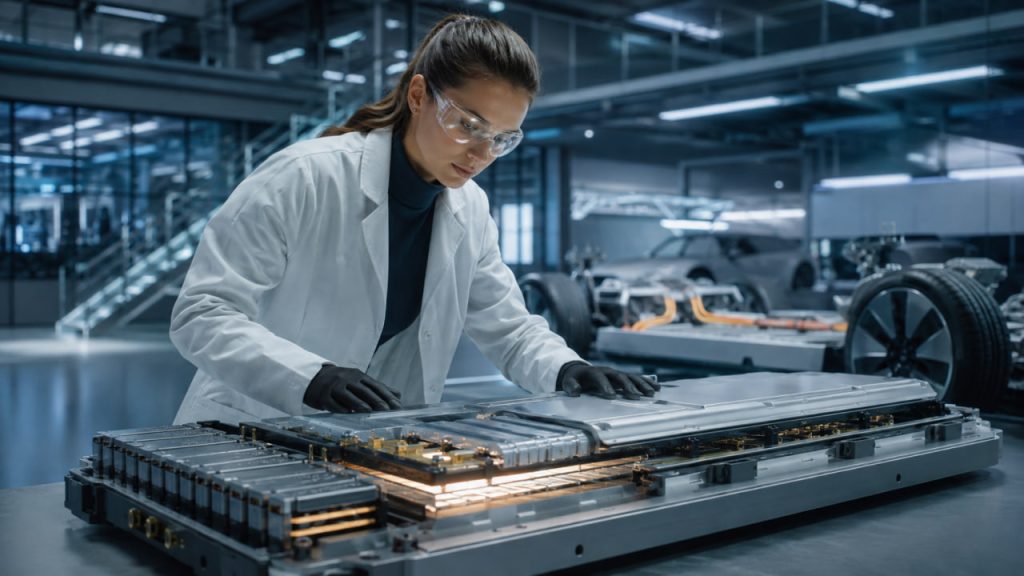
Electric vehicles have improved dramatically in little more than a decade. Battery packs are cheaper, charging speeds are higher, ranges are longer, and manufacturers have learned how to manage temperature, safety, and degradation far more effectively than in the early years of mass-market EVs.
Yet the basic architecture of most electric-car batteries remains familiar: lithium-ion cells containing a liquid or gel electrolyte that allows lithium ions to move between the cathode and anode.
Solid-state batteries promise to change that formula.
Instead of relying on a conventional liquid electrolyte, they use a solid electrolyte. In theory, this can enable batteries with greater energy density, faster charging, improved thermal stability, lower weight, and potentially the use of lithium-metal anodes.
The promise is enormous. So is the engineering challenge.
Toyota, Nissan, Honda, Mercedes-Benz, Stellantis, Volkswagen-backed PowerCo, QuantumScape, Factorial Energy, and other companies are spending heavily to move solid-state technology from laboratory cells into real vehicles.
The key question is no longer whether solid-state batteries can work. It is whether they can be manufactured reliably, affordably, and in millions of automotive-grade cells.
What Is a Solid-State Battery?
Every rechargeable lithium battery needs a path through which lithium ions can travel between its electrodes.
In a conventional lithium-ion battery, that transport occurs through a liquid electrolyte. Separators prevent the positive and negative electrodes from directly touching while allowing ions to move.
A true all-solid-state battery replaces the liquid electrolyte and conventional separator arrangement with a solid ion-conducting material.
Several families of solid electrolytes are under development, including:
- Sulfide-based materials
- Oxide ceramics
- Polymers
- Composite electrolytes
- Other proprietary solid materials
The chemistry matters because each approach offers different advantages and manufacturing problems.
Sulfide electrolytes can offer high ionic conductivity and may work well with manufacturing methods suited to high-volume battery production, but they can be chemically sensitive and difficult to process.
Ceramic electrolytes may provide excellent stability but can be brittle and challenging to manufacture in large, thin layers.
Polymer-based systems can be easier to process but may not achieve the same conductivity or performance across all temperatures.
There is therefore no single universal “solid-state battery.” Different companies are pursuing substantially different technologies under the same broad name.
Why Solid-State Batteries Could Transform Electric Cars
The most important potential benefit is energy density.
Higher energy density means storing more energy in the same mass or volume.
For an electric vehicle, manufacturers could use that advantage in several ways.
They could build a similar-size battery with significantly greater range. Alternatively, they could maintain today’s range while using a smaller, lighter pack.
The second possibility may ultimately be more important.
A smaller battery can reduce:
- Vehicle weight
- Raw-material consumption
- Structural requirements
- Charging energy
- Suspension loads
- Tire wear
- Manufacturing cost
A lighter EV may also become more efficient, creating a positive cycle in which less battery is required to achieve a given range.
Some solid-state designs also aim to use lithium-metal anodes instead of conventional graphite-based anodes. Lithium metal has extremely high theoretical capacity, making it especially attractive for next-generation high-energy batteries.
Solid-State Batteries Could Charge Much Faster
Fast charging is another major target.
Today’s best lithium-ion EVs can already replenish a large portion of their battery in roughly 15 to 30 minutes under ideal conditions. But repeatedly pushing large amounts of power into conventional cells creates heat and places demanding constraints on the electrodes and electrolyte.
Some solid-state designs could tolerate much higher charging rates.
Toyota has said that its planned all-solid-state technology is targeting approximately 10 minutes or less for charging from 10 to 80 percent, alongside higher energy density and increased driving range. The company continues to target practical use around 2027 or 2028.
Those figures are targets rather than guarantees for a future production vehicle.
Charging performance also depends on more than the cell itself. A car still requires suitable cables, cooling systems, battery electronics, charging infrastructure, and a grid connection capable of supplying very high power.
Nevertheless, a genuine 10-minute 10-to-80-percent charging capability would significantly reduce one of the remaining psychological and practical disadvantages of electric cars.
Safety Could Improve, but “Solid” Does Not Mean Indestructible
Solid-state batteries are frequently described as safer than conventional lithium-ion batteries.
There is a good reason for that.
Many conventional electrolytes contain flammable organic solvents. Replacing them with a more thermally stable solid material can reduce one important pathway to fire.
Solid electrolytes can also improve resistance to leakage and potentially tolerate higher temperatures.
However, marketing sometimes oversimplifies this advantage.
Solid-state batteries still store enormous quantities of energy. Lithium-metal systems can develop internal defects. Cells can still short-circuit, overheat, or fail after mechanical damage.
A solid-state pack therefore still requires:
- Crash protection
- Thermal monitoring
- Battery-management electronics
- Cell isolation
- Manufacturing quality control
- Safe charging limits
Solid-state technology may reduce some battery hazards, but it does not eliminate the laws of physics or the need for sophisticated safety engineering.
The Dendrite Problem
One of the most important obstacles is dendrite formation.
When lithium metal is repeatedly deposited and removed during charging and discharging, microscopic structures can form.
If those structures grow through the electrolyte and create an internal electrical connection between the electrodes, the cell can short-circuit.
A solid electrolyte sounds as though it should automatically stop this process, but reality is more complicated.
Microscopic defects, interfaces between materials, uneven pressure, and local current concentrations can allow undesirable lithium growth.
Researchers have therefore spent years developing electrolytes, interfaces, protective layers, pressure-control systems, and manufacturing methods designed to stabilize lithium-metal cycling.
Solving this in one laboratory cell is difficult.
Solving it in millions of large-format automotive cells that must survive thousands of cycles, freezing winters, desert heat, vibration, fast charging, and manufacturing variation is much harder.
Interfaces Are One of the Biggest Engineering Challenges
Liquid electrolytes have an important practical advantage: they naturally flow into microscopic gaps between electrode materials.
Solid materials do not.
For a solid-state cell to work efficiently, its internal layers need intimate physical contact. Tiny gaps can increase resistance, reduce performance, and contribute to degradation.
Toyota has specifically highlighted the need to keep the cathode, anode, and solid-electrolyte layer tightly bonded. The company says it has developed high-speed, high-precision stacking techniques intended to support future manufacturing.
Some solid-state systems also require controlled mechanical pressure to maintain good contact as the electrodes expand and contract during charging.
That creates another challenge for vehicle designers.
A laboratory fixture can apply pressure relatively easily. A production battery pack must maintain appropriate pressure for years without becoming excessively heavy, complicated, or expensive.
Manufacturing Is the Real Battlefield
The history of battery technology is filled with impressive laboratory prototypes.
Cars need factories.
Automotive cells must be produced at high speed with extremely low defect rates. A battery plant may manufacture millions of cells, and even a tiny percentage of critical defects can become unacceptable at that scale.
Solid-state production introduces unfamiliar requirements involving material handling, dry processing, pressing, sintering, coating, stacking, environmental control, and quality inspection.
Honda has already built a demonstration production line in Japan specifically to study how all-solid-state batteries can be manufactured at scale. The approximately 27,400-square-meter facility includes equipment for electrode preparation, coating, roll pressing, cell formation, and module assembly. Honda says the line is intended to verify mass-production methods and costs rather than merely prove that individual cells function.
That distinction explains why commercial timelines have repeatedly slipped.
The breakthrough the industry needs is not another record-setting prototype cell. It is a repeatable manufacturing process with automotive reliability and competitive cost.
Toyota Is Targeting 2027–2028
Toyota has become one of the most prominent proponents of all-solid-state batteries.
The company is working with Idemitsu Kosan on sulfide solid electrolytes and says it intends to introduce battery-electric vehicles using all-solid-state technology around 2027 to 2028.
Toyota has previously outlined targets including about 20 percent more cruising range than one of its planned high-performance liquid-electrolyte batteries and 10-to-80-percent charging in 10 minutes or less.
However, initial production will not necessarily resemble today’s high-volume battery manufacturing.
Toyota has discussed initial capacity on the scale of tens of thousands of vehicles per year rather than millions.
That is a crucial detail.
A first commercial solid-state Toyota would represent a major technological milestone, but it would not mean that conventional lithium-ion batteries suddenly disappear from dealerships.
Nissan Is Also Aiming for 2028
Nissan has its own all-solid-state program and has publicly targeted the launch of an EV using internally developed ASSB technology in fiscal year 2028.
The company’s longer-term vision is to use solid-state batteries across a wider range of vehicle segments.
That could be especially important for vehicles where today’s battery limitations are most obvious.
Large SUVs, pickups, performance cars, commercial vehicles, and long-range models benefit disproportionately from higher energy density because they otherwise require very large and heavy battery packs.
Solid-state technology could therefore appear first in relatively expensive or technically demanding vehicles before spreading toward affordable mass-market models.
Mercedes-Benz Has Already Put Solid-State Batteries on the Road
One of the strongest signs of progress came from Mercedes-Benz and Factorial Energy.
Mercedes began road testing a modified EQS equipped with a lithium-metal solid-state battery in early 2025. The manufacturer said the experimental pack could offer about 25 percent greater range while remaining comparable in size and weight to the standard battery.
Later that year, the test vehicle completed a 1,205-kilometer journey from Stuttgart to Malmö without recharging and arrived with 137 kilometers of indicated range remaining.
That does not mean a production Mercedes with the same battery is immediately ready.
Prototype vehicles can use expensive hardware, carefully selected cells, extensive instrumentation, and engineering solutions that would be unsuitable for mass-market manufacturing.
Still, road testing matters because automotive batteries must work outside controlled laboratories.
Mercedes technology chief Markus Schäfer described vehicle-scale testing as an important way to gain knowledge for possible series integration of solid-state technology.
Stellantis and Factorial Are Moving into Vehicle Testing
Factorial is also working with Stellantis.
In 2026, the companies announced road testing of a development vehicle using Factorial’s FEST solid-state cells. Earlier cell testing demonstrated approximately 375 Wh/kg energy density and charging from 15 to 90 percent in 18 minutes under test conditions.
The road-test program is particularly important because engineers must validate complete battery packs rather than individual cells.
That includes:
- Thermal behavior
- Mechanical expansion
- Pack pressure
- Charging control
- Crash protection
- Software calibration
- Cold-weather operation
- High-temperature durability
- Long-term reliability
Moving from laboratory cells to a working automotive pack is one of the most difficult stages of battery development.
Volkswagen Is Betting on QuantumScape
QuantumScape has pursued a different route based around solid-state lithium-metal technology.
Volkswagen Group battery company PowerCo expanded its collaboration with QuantumScape in 2025, with additional milestone-based funding intended to support industrialization and pilot-line development.
The commercial model is notable.
Rather than simply building all future cells itself, QuantumScape has increasingly emphasized licensing technology and working with large-scale manufacturing partners.
This reflects another reality of the battery industry: a breakthrough chemistry and a successful factory are two separate capabilities.
Even if a startup develops an exceptional cell, automotive-scale manufacturing may require the capital, production expertise, supply chain, and quality-control systems of an established industrial group.
Conventional Lithium-Ion Batteries Are Not Standing Still
Solid-state technology is racing against a moving target.
Today’s liquid-electrolyte lithium-ion batteries continue to improve.
Manufacturers are developing:
- Higher-energy nickel-based cells
- Improved lithium iron phosphate batteries
- Manganese-rich chemistries
- Silicon-enhanced anodes
- Cell-to-pack structures
- Structural battery systems
- Faster charging
- Improved thermal management
Toyota itself plans several next-generation liquid-electrolyte battery families alongside its solid-state program.
This matters because solid-state batteries do not need merely to work.
They need to offer enough additional value to justify new factories, supply chains, materials, engineering systems, and manufacturing risk.
If conventional cells become cheaper, safer, and faster-charging at the same time, the commercial threshold for solid-state becomes higher.
Will Solid-State Batteries Make EVs Cheap?
Eventually, they could help.
Initially, they are more likely to be expensive.
Early production will have limited scale, specialized materials, high capital costs, lower manufacturing yields, and substantial research expenditure.
Premium EVs are therefore logical first customers.
A luxury manufacturer can absorb a battery premium more easily if the technology enables:
- Exceptional range
- Lower weight
- Faster charging
- Better performance
- More interior space
High-performance cars may also value the power-to-weight advantages.
Only after factories mature and production yields improve should prices begin moving toward mainstream levels.
Solid-state batteries are more likely to enter the market from the top down than suddenly make entry-level EVs dramatically cheaper.
When Should Buyers Expect the Real Breakthrough?
The late 2020s now look increasingly credible for the first meaningful automotive introductions.
Toyota is targeting 2027–2028. Nissan is aiming for fiscal 2028. Honda is validating production methods. Mercedes and Stellantis are conducting real-vehicle tests. Volkswagen and PowerCo are supporting QuantumScape’s industrialization efforts.
But commercialization is not the same as widespread adoption.
A realistic progression is likely to be:
- Experimental and demonstration vehicles.
- Limited production in premium or specialized models.
- Gradual factory expansion.
- Improvements in yield and durability.
- Cost reductions.
- Broader introduction across mainstream vehicle segments.
That process could extend well into the early 2030s.
The first solid-state EV does not need to be perfect to represent a breakthrough. It only needs to prove that the technology can survive real automotive use and can be manufactured consistently enough to justify expansion.
Conclusion
Solid-state batteries are closer to reality than they were a few years ago.
The technology has moved beyond tiny laboratory samples. Automotive-scale packs are being assembled, demonstration factories are operating, and prototype cars are accumulating real road mileage.
The potential advantages remain compelling: higher energy density, lower weight, rapid charging, improved thermal stability, and the possibility of practical lithium-metal anodes.
But the remaining barriers are primarily industrial.
Engineers must control dendrites, maintain reliable interfaces between solid materials, manage expansion and pressure, guarantee long cycle life, and manufacture enormous numbers of nearly flawless cells at competitive prices.
Toyota and Nissan are pointing toward 2027–2028 for early commercialization, while Mercedes-Benz, Factorial, Honda, QuantumScape, PowerCo, and others are progressing through vehicle testing and manufacturing scale-up.
The most likely solid-state battery breakthrough will therefore not happen on one dramatic day. It will unfold gradually from the late 2020s into the 2030s, beginning with expensive limited-production vehicles before reaching ordinary mass-market EVs.
When that transition finally scales, the biggest change may not be a car with an enormous 1,500-kilometer battery. It may be something more useful: an EV that travels today’s distances with a smaller, lighter battery, charges in minutes, uses fewer materials, and costs less to operate.
That is the breakthrough the automotive industry is really waiting for.